

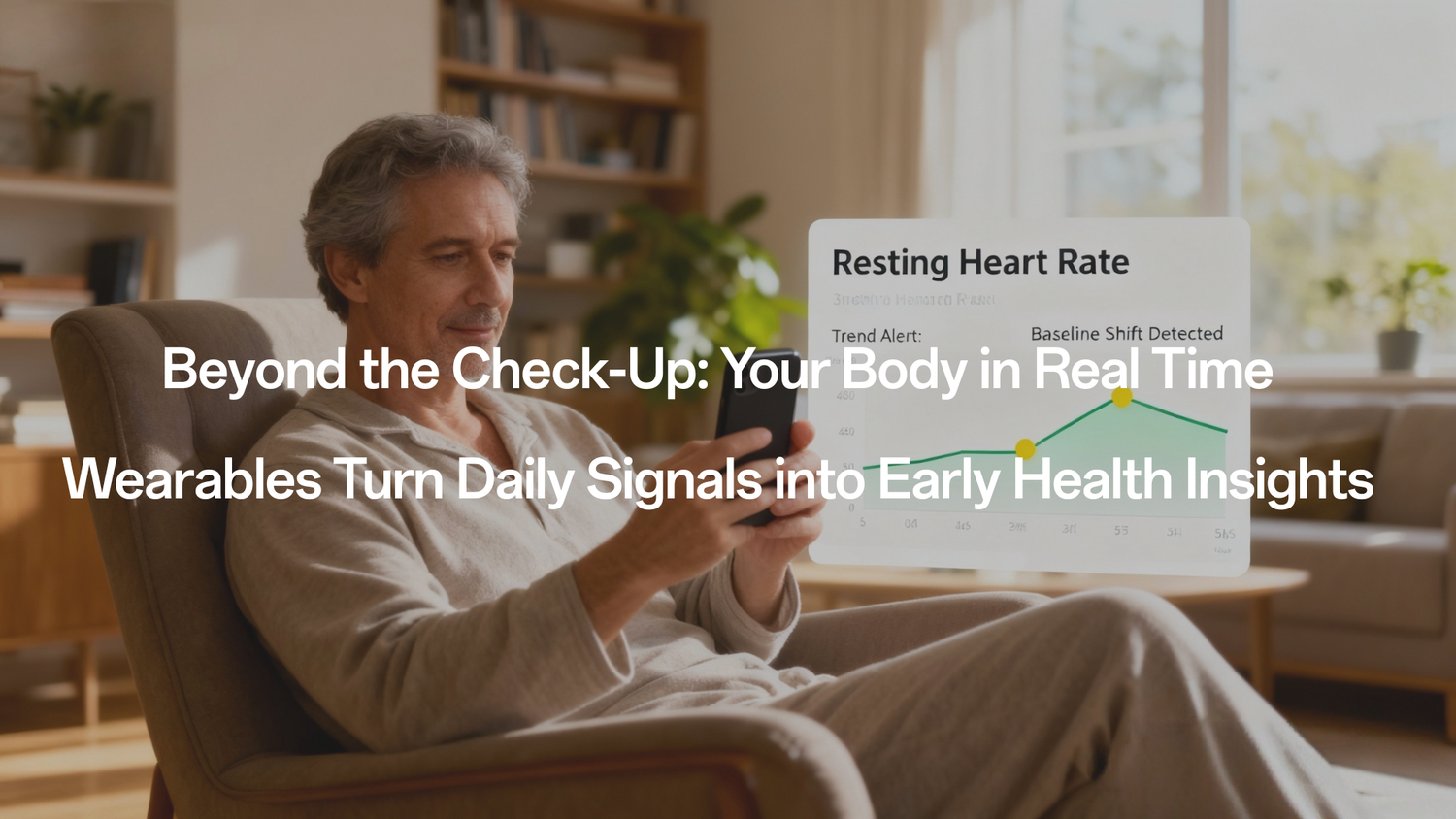
Every year, millions of people step into a clinic for their “annual check-up.” Fifteen minutes later, they walk out with numbers that may or may not represent who they really are. This scenario highlights the core limitation of conventional health assessment: the reliance on a single, isolated measurement, or "clinical snapshot". This method yields data with "unknown generalizability" to real-world situations, creating a critical gap between where health data is collected (the lab) and where intervention is truly needed (daily life) (Roos & Slavich, 2023, Brain, Behavior, and Immunity).
Wearable technology—affordable, scalable, and noninvasive—is fundamentally challenging this model by offering continuous, high-frequency assessments of our ever-changing physiological states (Roos & Slavich, 2023, Brain, Behavior, and Immunity). The real revolution lies in this continuous data stream—the "time dimension"—which provides a powerful, personalized foundation for disease prediction far superior to any single traditional test.
I. The Predictive Power of the Longitudinal Baseline
The strength of wearable devices is their ability to monitor intra-individual changes minute-to-minute and month-to-month, enabling real-time feedback and early disease detection (Roos & Slavich, 2023, Brain, Behavior, and Immunity). This predictive advantage is particularly evident when assessing chronic conditions like metabolic syndrome (MetS), a major risk factor for cardiovascular disease.
Traditional clinical practice often relies on Resting Heart Rate (RHR) measured in a doctor's office. However, this single measurement may be influenced by anxiety or activity, failing to capture the body's true physiological baseline. In contrast, researchers can calculate continuous HR metrics derived from wearables, such as Inactive Heart Rate (HR measured during periods of minimal activity) or Minimum Heart Rate (Mun et al., 2024, Scientific Reports). A study on MetS risk found that models incorporating these wearable-derived continuous heart rate indices exhibited better predictive utility than models based on single clinical RHR measurements in men (Mun et al., 2024, Scientific Reports). For instance, a 10 bpm increase in Minimum HR was significantly associated with a risk increase of 4.21 times for Pre-MetS or MetS in male participants (Mun et al., 2024, Scientific Reports).
What this means: The continuous time dimension reveals health trends that a single measurement misses. It demonstrates that MetS-related heart rate changes can be identified in the early stages of the disease, long before a patient meets full clinical diagnostic criteria (Mun et al., 2024, Scientific Reports). Continuous tracking allows researchers to capture subtle changes in autonomic function and physiological state in real-time. But among the endless stream of data points, one window stands out for its clarity and stability—sleep.
II. The Night Shift: Sleep as the Gold Standard for Accuracy
For wearable data to be trustworthy, it must be accurate. The continuous time dimension provides its most reliable insights during sleep, when motion artifacts are minimized and the body approaches a stable baseline (Hardon et al., 2025, JMIR Formative Research).
- Reliability Under Controlled Conditions: HRV measurement is highly reliable when performed under standardized conditions, such as consistent timing and posture control (Besson et al., 2025, Scientific Reports). A study showed that time-domain HRV metrics like RMSSD and HR exhibited good-to-excellent reliability across multiple sessions and environments (home vs. lab) (Besson et al., 2025, Scientific Reports).
- The Clarity of Stillness: This reliability is especially crucial in clinical monitoring. A prospective study validating heart rate trackers in children with heart disease demonstrated that HR accuracy during sleep time (up to 90.8% accuracy for Hexoskin) was significantly higher than the accuracy during wake time (up to 86.1% accuracy for Hexoskin) (Hardon et al., 2025, JMIR Formative Research). This difference highlights the necessity of using the time dimension strategically to obtain actionable, high-quality data. In validation studies focused on nocturnal monitoring, highly optimized devices—such as specific ring wearables—achieved near-perfect agreement with gold-standard ECG reference devices for HRV measurements (Dial et al., 2025, Physiological Reports).
What this means for users: Sleep offers a crucial window into autonomic function that is insulated from daily movement and acute stress. This accurate, continuous overnight data provides healthcare providers with a stable, reliable physiological baseline that is superior to a single reading taken in a hurried clinical setting.
III. Even the Smartest Sensors Have Blind Spots: PRV is Not HRV
The tremendous potential of continuous data must be weighed against current technical limitations. Even the most capable sensors have blind spots, especially when relying on optical (PPG) technology. The fundamental difference between Pulse Rate Variability (PRV) and true Heart Rate Variability (HRV) is one of them.
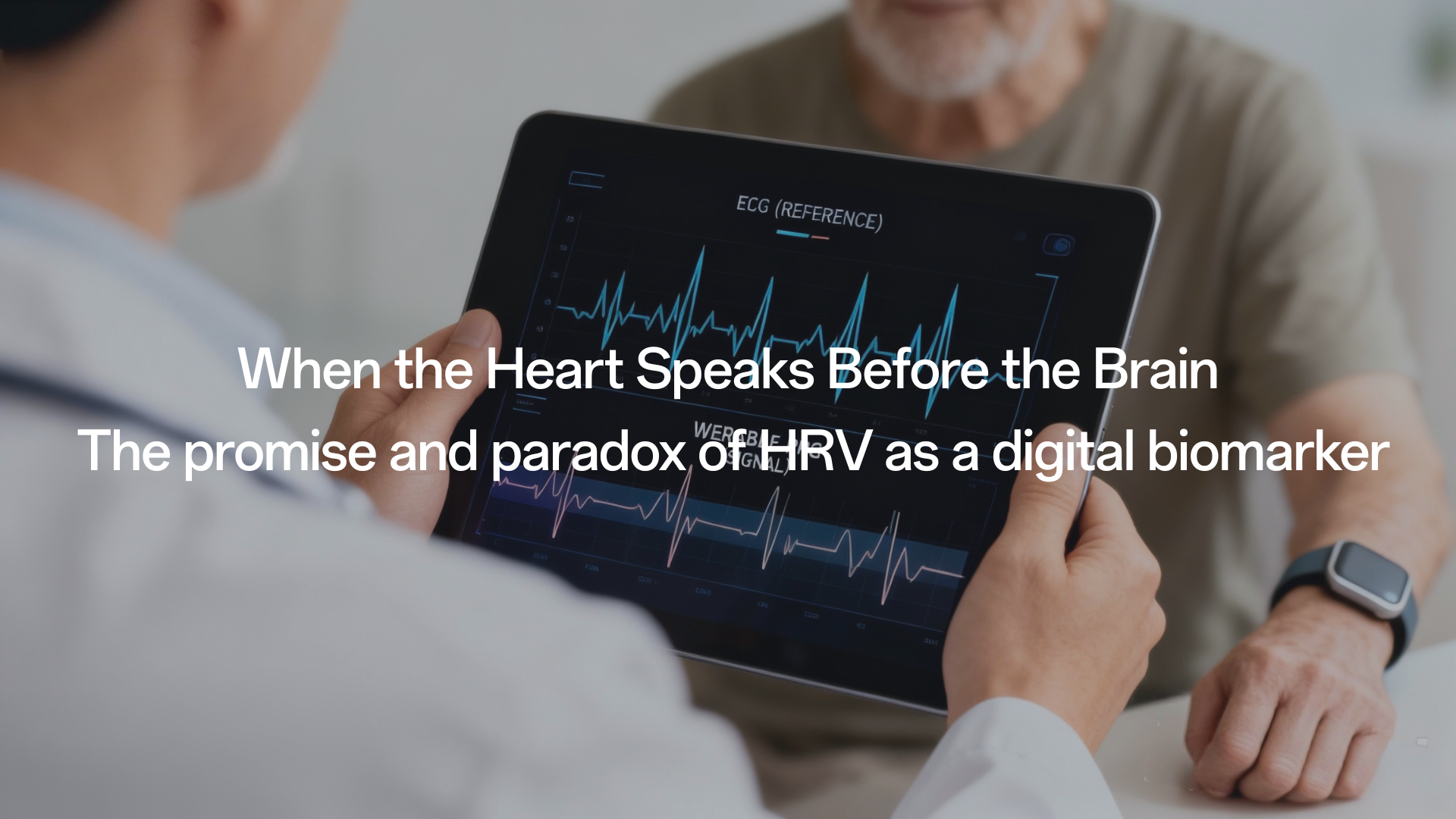
- The Technical Disconnect: Wearable PPG sensors measure blood volume changes (PRV), not the heart’s electrical signal (HRV). This distinction matters significantly in health measurement. A large clinical study across a diverse patient population found a significant disagreement between PPG-derived PRV and ECG-derived HRV metrics (Kantrowitz et al., 2025, Front. Physiol.). This systemic difference—often resulting in the underestimation of HRV values—makes the widespread replacement of HRV with PRV in journals and marketing "unacceptable and dangerous" in healthcare contexts where precise diagnosis is required (Kantrowitz et al., 2025, Front. Physiol.).
- The Flaw of Dynamics: The performance of many wrist-worn devices further declines when the body is in motion or transitioning quickly between states. A validation study focusing on real-life monitoring showed that heart rate accuracy "notably declined across all wrist-worn devices during transient states"—periods of rapid physiological change (Van Oost et al., 2025, Sensors). This highlights that continuous time tracking is only valuable if the signal quality remains high, a challenge often faced by PPG devices during movement. Conversely, a separate study found that PPG-derived HRV "cannot replace ECG derived HRV" due to non-uniform measurement error (Maleczek et al., 2025, Front. Physiol.).
IV. The Horizon: From Chronic Monitoring to Real-Time Intervention
Despite current limitations in PPG accuracy during movement, the ability to collect long-term, high-frequency physiological data remains transformative for advancing both diagnosis and intervention outside the hospital walls (Roos & Slavich, 2023, Brain, Behavior, and Immunity).
- Early Diagnosis of Neurological Disease: Long-term, high-quality ECG monitoring from wearable devices has opened new avenues for diagnosing complex diseases early. For instance, autonomic dysfunction often appears in Parkinson's Disease (PD) before motor symptoms (Park et al., 2025, Frontiers in Aging Neuroscience). A study using a wearable ECG patch to monitor PD patients and controls for up to 72 hours found that certain HRV indicators had good diagnostic accuracy for distinguishing PD patients, achieving an Area Under the Curve (AUC) of 0.935 (Park et al., 2025, Frontiers in Aging Neuroscience).
- Guiding Just-in-Time Interventions: Beyond diagnosis, the continuous time dimension provides the empirical data required to guide "just-in-time adaptive interventions" (JITAI) (Roos & Slavich, 2023, Brain, Behavior, and Immunity). By developing machine learning algorithms that identify distinct physiological states, such as an acute stress response, researchers can test hypotheses related to stress processes in real-time (Roos & Slavich, 2023, Brain, Behavior, and Immunity). This potential for real-time monitoring and feedback is designed to enhance adaptive recovery or intervene before pre-clinical deterioration (Roos & Slavich, 2023, Brain, Behavior, and Immunity).
What this means for the field: The utility of continuous data extends far beyond general wellness; it is enabling new paradigms for clinical decision support and personalized medicine aimed at intervening before disease processes are fully established (Roos & Slavich, 2023, Brain, Behavior, and Immunity).
Conclusion: Rewriting the Healthcare Timeline
The shift from the clinical snapshot to the continuous, time-stamped physiological narrative is the true revolution brought by wearable technology. By leveraging continuous data—especially the highly reliable metrics captured during rest—we gain clarity and predictive power that transcends the limitations of single clinical assessments (Jamieson et al., 2025, npj Cardiovascular Health). This precision allows us to move beyond simply diagnosing disease after it manifests.
This shift doesn’t just change how we measure health — it redefines when healthcare begins.

Efterlad en kommentar
Denne side er beskyttet af hCaptcha, og hCaptchas Politik om beskyttelse af persondata og Servicevilkår er gældende.