

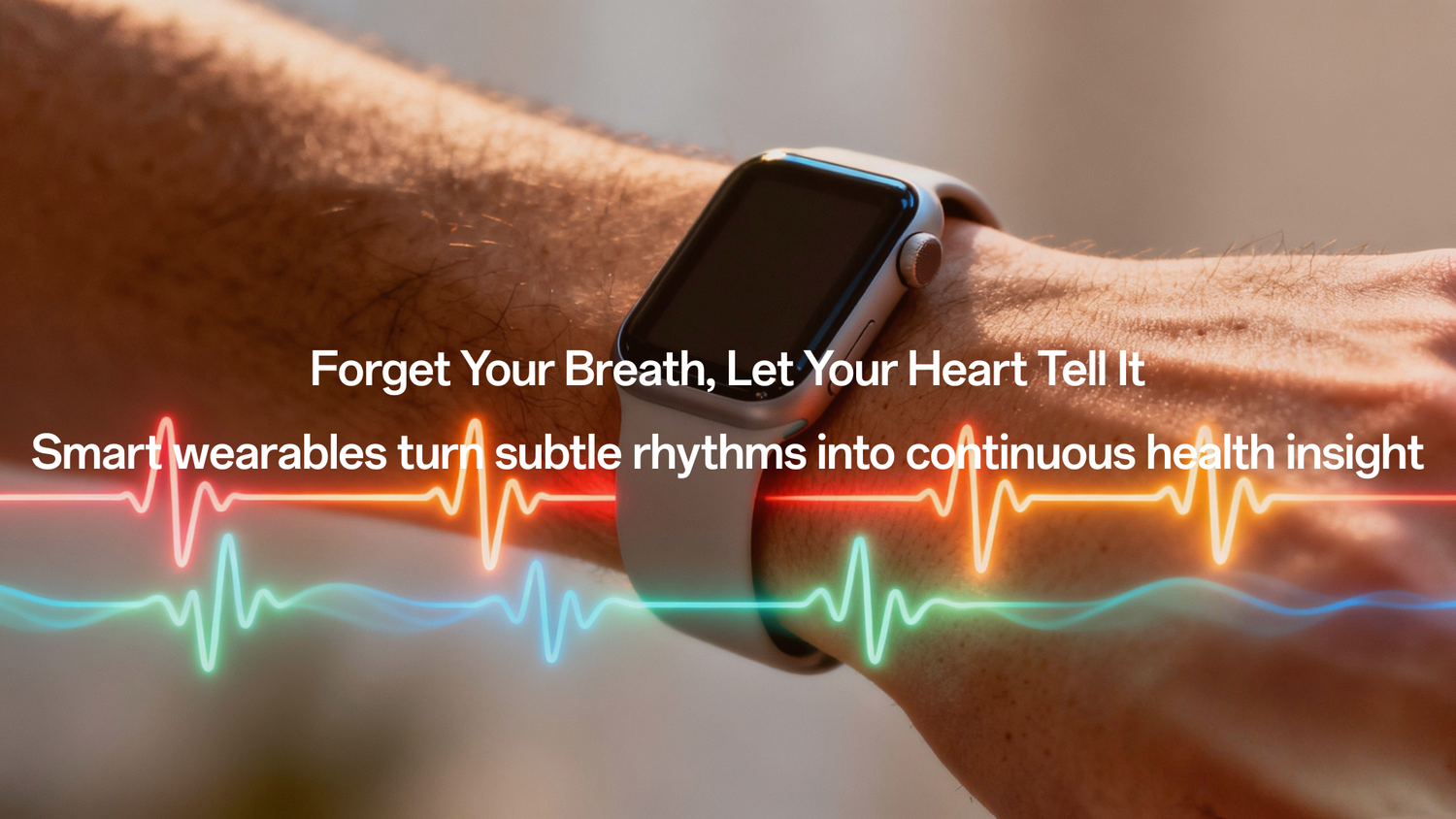
I. The Old World's Failure: Accuracy Cannot Compete with Destiny
Respiratory Rate (RR) is arguably the most neglected, yet most vital, sign in medicine. Abnormal RR is a proven, early predictor of serious clinical events, often outperforming pulse and blood pressure in discerning stable patients from those at risk. However, achieving accurate, continuous RR monitoring outside of a clinical setting has long been paralyzed by an insurmountable conflict: The Utility Paradox.
On one side stands accuracy, represented by instruments like spirometry, capnography, or chest bands. These methods are precise—they measure airflow or thoracic movement directly. Yet, they are invasive, costly, often require equipment typically found only in Intensive Care Units, and cause significant patient inconvenience. Devices using stretchable sensors in belts, while offering stability during activity, are deemed uncomfortable for prolonged wear and may even affect natural breathing movements. Even advanced solutions, like the "Health Patch" designed for comfort and wearability, showed a marginal agreement in respiratory rate detection, with a Lin’s concordance coefficient of just 0.56 compared to a gold standard capnography during exercise.
On the other side is the market demand: unobtrusive, 24/7 monitoring.
This is the breaking point. It is not merely a technical limitation, but a biological inevitability. If respiration cannot be measured comfortably at its source—the chest wall or the airway—the only viable strategy is to measure it where the body records its systemic consequences. The heart becomes the silent memory of the breath.
II. The Necessary Shift: Why Cardiac-Derived Sensing is the Wearable’s Only Route
The future of generalized wearable monitoring belongs to indirect, cardiac-derived methods (EDR, PPG-RR, Bio-Z). This shift is not an engineering shortcut; it is a destiny dictated by the demands of comfort, ubiquity, and efficiency.
1. The Power and Form Factor Mandate
For a device to be truly wearable, it must melt into the background of daily life, integrated into products users already embrace, like rings and watches.
-
Miniaturization & Mass Adoption: Commercial wearables, such as those relying on PPG sensors, are widely available and practical for monitoring basic physiological functions. Crucially, the respiration rate in these areas is primarily derived only from heart rate variability (HRV). Companies are actively integrating these solutions into rings and smartwatches, capitalizing on their non-intrusive nature.
-
Extreme Energy Efficiency: Direct gas or high-frequency acoustic monitoring consumes significant power. In stark contrast, specialized processors designed for ECG-derived respiration (EDR) estimation have achieved remarkably low power consumption, hitting figures as low as 354 nW. This ultra-low power footprint is the foundation for any device promising days or weeks of continuous, unattended service.
2. The Multi-Purpose Advantage
Indirect methods eliminate the need for dedicated, single-function respiratory hardware (like chest straps) by simultaneously drawing multiple vital signs from the same sensor input. These devices provide a comprehensive picture of the wearer’s current physiological state, offering multifunctionality that is highly suitable for general health monitoring. This is evidenced by commercially available PPG/ECG sensors, which are a "good and practical solution" due to their wide availability and ability to deliver continuous, non-intrusive monitoring.
III. The Biological Signature: How Breathing Leaves Its Mark on the Pulse
The key insight that justifies this paradigm shift is the cardiorespiratory interaction—the constant, predictable dialogue between the lungs and the circulatory system.
1. The Frequency Fingerprint in Mechanical Signals
Mechanical sensors, like seismocardiography (SCG) and ballistocardiography (BCG), capture the micro-vibrations induced by the heart and lungs. While the signal appears chaotic, it contains two distinct signatures based on frequency:
-
The low-frequency component of the SCG signal matches the chest wall motion induced by respiration.
-
The high-frequency component matches the heartbeat.
The Insight: Because the cardiovascular and respiratory systems record their activity in separate frequency bands on the same mechanical signal, sophisticated algorithms can precisely isolate and analyze both dynamics concurrently. This unique ability to observe cardio-respiratory dynamics outside the hospital is a powerful argument for SCG/BCG’s use in sleep monitoring, demanding sports, and mental tasks.
2. The Electrical and Hemodynamic Modulation
Breathing physically and electrically alters the heart's signals:
-
The Electrical Tilt (EDR): As the chest moves, the electrodes measuring the ECG shift in distance and direction, inducing predictable variations in the QRS complex amplitude. This "electrical tilt" is what EDR algorithms track, confirming that ECG-derived breathing is principally derived from chest movements and changes in the impedance distribution of the human chest.
-
The Rhythmic Heartbeat (RSA): The most subtle form is respiratory sinus arrhythmia (RSA), where HRV is synchronized with respiration—the RR interval shortens during inspiration and lengthens during expiration. This is the fundamental mechanism used by most commercial wearables (often using PPG) to calculate RR, providing an essential window into the autonomic nervous system.
IV. The Engineering Edge: Algorithms Redeem the Sensor’s Flaw
The most persistent criticism of cardiac-derived measurement—its susceptibility to motion artifacts (MA)—is not a dead end, but the ultimate accelerator for innovation.
1. AI Transforms Noise into Resilience
EDR accuracy is fundamentally influenced by artifacts. The low signal quality of PPG, especially in the presence of MA, has historically limited its diagnostic utility. However, this flaw is now being mitigated by AI, proving that software strength overcomes hardware inconvenience.
-
Data Fusion: Instead of relying on a single imperfect signal, wearable systems are incorporating multiple sensors, such as integrating ECG or PPG with an inertial measurement unit (IMU) (accelerometers). This fusion strategy enables algorithms to use movement data to filter out signal interference.
-
Deep Learning for Robustness: Advanced techniques using convolutional neural networks (CNN) and machine learning are specifically developed to estimate RR even in the presence of motion. These algorithms improve the device's ability to recognize and interpret different breathing patterns and ensure efficiency and accuracy.
2. Robustness Across All Users
The algorithmic approach ensures that the indirect measurement remains robust across diverse real-world conditions. A validation study on a wearable PPG-based sensor, which measures RR across a wide range of 4–59 breaths per minute (brpm), demonstrated that the proposed algorithm showed no significant differences (p = 0.63) in accurately determining RR values in subjects with darker skin tones. This proves that the combination of PPG and accelerometer algorithms can overcome optical challenges related to skin pigmentation, which traditionally compromise optical sensors.
V. The New Insight: What Continuous Data Reveals About Your Health
The true value of continuous, indirect monitoring is the shift in health discourse. Wearables of the future will not merely record isolated statistics; they will report dynamic physiological insight that directly impacts a user’s awareness of stress, recovery, and risk.
-
The Stress Report: By tracking HRV and RSA, the device provides real-time data on the autonomic nervous system. For instance, a bed-embedded BCG monitor can meticulously record HR, HRV, breathing cycles, sleep cycles, movements in bed, overall recovery, and stress levels. The continuous monitoring of respiration, along with heart data, can be utilized for stress assessment.
-
The Apnea Alert: Indirect methods are perfectly suited for long-term sleep monitoring, where the lack of movement minimizes noise. Algorithms like kPCA are particularly suitable for accurate sleep apnea detection and home monitoring. The ability of BCG and SCG to detect hemodynamic changes during simulated obstructive apnea offers a new diagnostic pathway outside of a clinic.
-
Breathing Depth and Disease Progression: While EDR is primarily used for RR, it can also be used to track changes in tidal volume (TV), which is the depth of breathing. This ability to assess breathing patterns provides valuable information about disease progression, supporting the monitoring of conditions like asthma and chronic obstructive pulmonary disease (COPD).
Conclusion
The choice between the intrusive precision of the old world (chest straps, gas masks) and the imperfect practicality of the new world (rings, patches) is clear: utility is destiny.
Wearable devices cannot afford to measure respiration directly, as patients will not endure the discomfort or the necessity of frequent calibration and adjustments. Instead, the industry has universally converged on the inescapable technical route of listening to the heart for the memory of the breath. This approach—using EDR, PPG, Bio-Z, and SCG/BCG—is a technical compromise on instantaneous, clinical-grade precision that yields a strategic victory in long-term data fidelity and user compliance.
The system that truly understands your respiration is the one you forget you are wearing. The future of wearables is not about measuring harder, but about applying smarter AI to the body's subtle, coupled rhythms, transforming a momentary vital sign into a continuous, predictive narrative of health.

Efterlad en kommentar
Denne side er beskyttet af hCaptcha, og hCaptchas Politik om beskyttelse af persondata og Servicevilkår er gældende.