

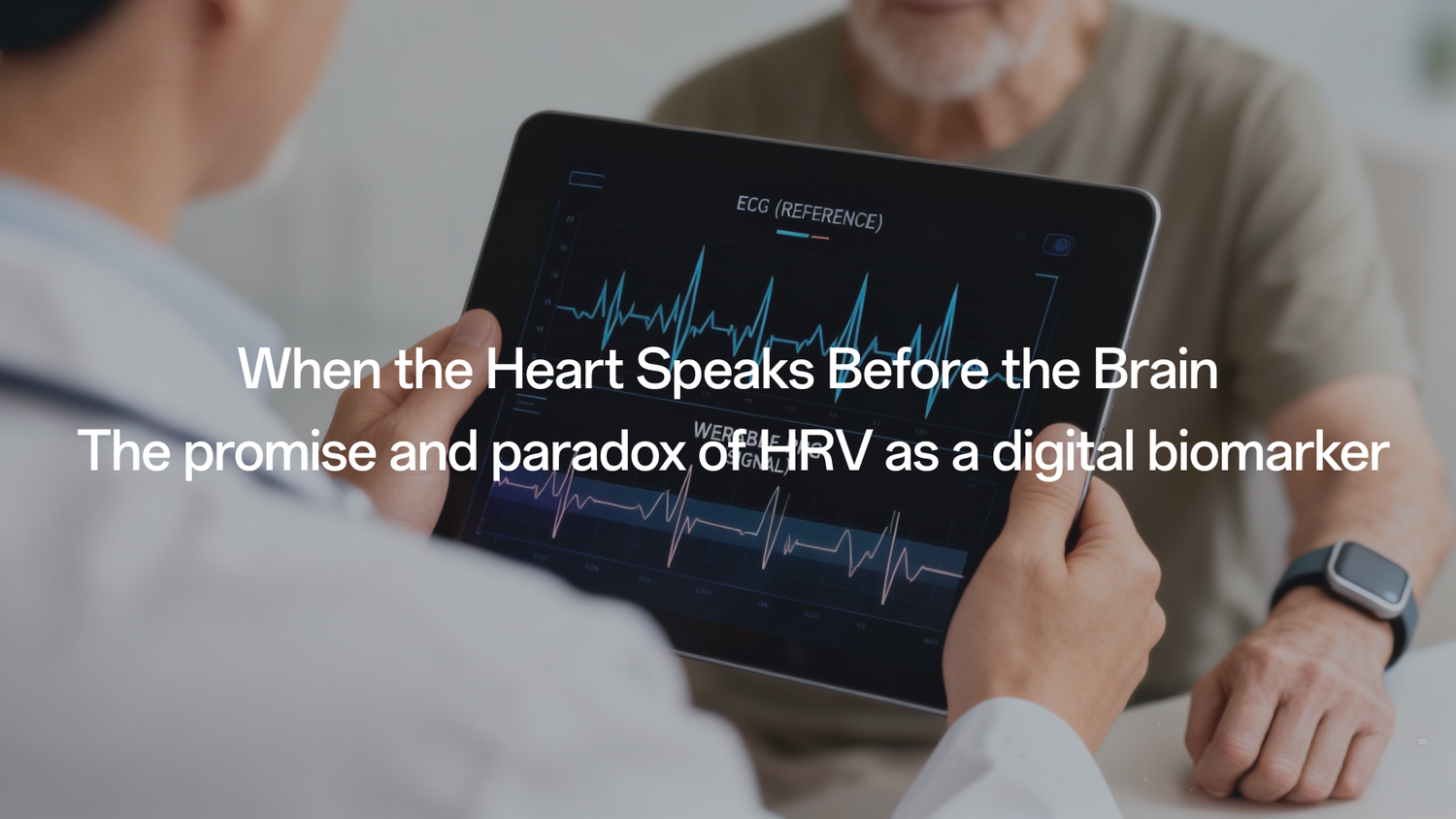
Your smartwatch may soon know more about your brain than your neurologist — at least, that’s what the data suggest.
For decades, assessing health meant a series of inconvenient and costly clinical snapshots, generating data with "unknown generalizability" to the chaos of daily life. Wearable technology, however, is fundamentally changing this model. These affordable, noninvasive devices provide a continuous, high-frequency stream of physiological data, enabling a profound shift: the ability to monitor chronic disease progression and potentially aid in early disease detection.
At the core of this revolution is Heart Rate Variability (HRV), a metric derived from the subtle fluctuations in the time between heartbeats. It is a sensitive index of the Autonomic Nervous System (ANS). While most consumers still track HRV to manage fitness and recovery, scientists are leveraging high-fidelity measurement to pursue a far more ambitious goal: transforming HRV into a high-accuracy digital biomarker for complex conditions like Parkinson’s Disease (PD).
I: The Clinical Breakthrough—HRV as PD’s Early Warning Code
The push to apply HRV to neurology is rooted in the fact that autonomic dysfunction—a change in HRV—often appears in PD before motor symptoms even begin. This continuous, high-quality ECG monitoring offers a way to capture the disease in its silent, prodromal phase.
1.1 Unmasking PD Through the Heartbeat
Researchers using wearable ECG devices to perform long-term monitoring (up to 72 hours) found that PD patients exhibited a clear, diminished HRV profile compared to healthy controls.
- High Diagnostic Power: PD patients showed significantly reduced levels in several key autonomic indicators, including SDNN, RMSSD, and LF power. When researchers integrated these HRV metrics with age and sex, the model achieved exceptional diagnostic accuracy for PD, yielding an Area Under the Curve (AUC) of 0.935. This suggests the model could distinguish Parkinson’s patients almost as accurately as many established neurological assessments.
- Connecting Heartbeat to Brain Damage: The significance of HRV data extends beyond simple correlation; it links the cardiac signal directly to the disease mechanism. The LF (Low-Frequency) power was found to be positively associated with the severity of the patient's tremor sub-score ($r=0.500$; $p=0.035$). This specific HRV metric was also negatively associated with the volume of the bilateral cerebellar cortical volume (a structure of the brain crucial for coordinating movement). This powerful insight demonstrates that HRV changes reflect a specific, tremor-associated pathophysiological process.
By integrating wearable ECG monitoring with advanced neuroimaging, this research establishes HRV not merely as a recovery score, but as a window into the integrity of the cerebellothalamocortical circuit.
II: The Siren’s Ambiguity—When Sensitivity Outruns Certainty
Yet even a metric as sensitive as HRV is not immune to ambiguity. What happens when a metric becomes too sensitive—when it reacts to everything, and means nothing specific?
When it comes to stress—the most ubiquitous health condition of modern life—HRV becomes less of a precise diagnostic code and more of a siren: loud, but often nonspecific.
2.1 The Stress Paradox: The Signal Is Neutral
It is well-established that HRV is a strong biomarker of stress. In high-pressure occupations, HRV indicators like SDNN and RMSSD were significantly lower during mission phases associated with heightened stress (like patient care and transport). This drop reliably confirms an acute physiological stress response.
However, this physiological signal is inherently neutral. The body’s core defense system responds identically to adaptive stress (e.g., vigorous exercise) and maladaptive stress (e.g., chronic anxiety). Researchers developing stress-detection algorithms must therefore ask a fundamental question: Is the device detecting a psychological stress response (requiring intervention) or a physiological stress response during exercise (requiring recovery)?. The physiological signals alone do not provide this critical information.
2.2 Why a Low HRV Score Does Not Guarantee Cardiac Safety
The belief that a drop in HRV automatically signals a cardiovascular threat is a dangerous assumption that has been challenged by real-world clinical research.
- Decoupling from Risk Markers: A study monitoring prehospital emergency physicians found no reliable correlation between HRV values (RMSSD and SDNN) and the occurrence of ST-T segment changes (ECG markers of potential cardiac alteration) during missions.
- The Paradoxical Link: In a perplexing contradiction to common stress literature, the study observed that higher SDNN values were sometimes associated with an increased likelihood of these ECG abnormalities ($OR = 1.06$; $95% CI: 1.02-1.10$).
This inconsistency strongly suggests that HRV alone is insufficient to detect ischemia-like changes or guarantee full cardiac safety during stressful events. Therefore, HRV should be viewed as a nonspecific indicator of ANS activation that requires external verification for clinical relevance.
III: Through the Filter—The Quest for Trustworthy Data
But the problem isn’t only biological—it’s also technical. For HRV to guide medicine and provide this critical clarity, the numbers must first be trustworthy.
The immense potential of digital biomarkers is constantly challenged by the mechanical limitations of the sensors that collect them. This technical struggle revolves around ensuring signal fidelity—the trustworthiness of the heart data being recorded.
3.1 The Technical Fog: Why PRV Is Not HRV
The greatest hurdle to clinical application lies in the distinction between the Gold Standard, ECG-derived HRV (measuring the electrical R-R interval), and the consumer metric, PPG-derived PRV (measuring blood volume changes).
- The Vascular Filter: As the pulse wave travels through the vasculature, the physical structure of the arteries acts as a structural low-pass filter. This process smooths out the minute, high-frequency fluctuations crucial for HRV analysis, leading to a loss of granularity.
- Systemic Underestimation: A large-scale clinical study using a diverse patient sample demonstrated that PRV metrics measured by PPG exhibited poor agreement with all ECG-derived HRV metrics. PRV was found to consistently underestimate key metrics like rMSSD, SDNN, and pNN50, showing systemically significant differences across major chronic conditions (cardiovascular, endocrine, neurological).
This inability to measure the precise R-R interval is not a minor error; it critically impacts a clinician’s ability to assess the severity of a condition, making the widespread replacement of "HRV" with "PRV" in medical contexts unacceptable and dangerous.
3.2 The Scientific Defense: Conquering the Noise
The solution to this technical fog is not to give up on wearables, but to use them intelligently, by seeking out contexts where noise is minimized, and by prioritizing ECG technology.
| Challenge | Scientific Solution and Evidence |
|---|---|
| Motion Artifacts / Dynamic Error | Focus on Stillness (Nighttime): Wearable performance declines notably during rapid heart rate changes and "transient states" (e.g., motion onset). Conversely, high-fidelity devices perform best during sleep when motion is minimized and the body is at a stable baseline. |
| PPG Low Granularity | Embrace the Ring: Finger-worn PPG devices, specifically the Oura Gen 4, demonstrated the highest agreement with gold-standard ECG for nocturnal HRV measurement, achieving a Lin's CCC of 0.99 and a Mean Absolute Percentage Error (MAPE) as low as 5.96%. This level of performance is near-perfect. |
| Need for Clinical Gold Standard | Integrated ECG Technology: For high-precision diagnosis (like PD), researchers are using specialized wearable ECG devices (e.g., patches, smart apparel). These technologies offer high accuracy for R-R interval measurement, providing the fidelity required for clinical decision-making. |
3.3 The Ongoing Battle: Resolving the Hidden Variables
Even with high-fidelity ECG integration, challenges remain that researchers and manufacturers are actively addressing:
- Proprietary Algorithms: Most manufacturers do not disclose the algorithms used for filtering, signal quality interpretation, or data interpolation. This "black box problem" limits the ability of researchers and clinicians to trust and compare device results.
- Individual Differences: Accuracy can be affected by factors like skin tone (green light PPG is more susceptible to reduced accuracy in darker skin tones due to increased melanin absorption) and age (older adults may show reduced PPG accuracy due to increased arterial stiffness).
- Next-Gen AI: Researchers are developing sophisticated algorithms, such as the deep regression network integrating a Bi-LSTM network, to map wearable signals to standard ECG waveforms with low error (mean RMSE of 0.09 mV). New algorithms are also integrating complementary sensor data (like accelerometry and temperature) to filter motion artifacts and differentiate psychological stress from physiological stress.
IV: The Wisdom Boundary—Where Data Becomes Meaning
The ability to continuously monitor health conditions is the empirical foundation for just-in-time adaptive interventions (JITAI)—intervening before pre-clinical deterioration takes hold. However, this future relies entirely on the final, irreplaceable step: human judgment.
4.1 Data Needs a Translator, Not a Replacement
HRV data, even when highly accurate, is a nonspecific indicator. For instance, an increase of 10 bpm in Minimum Heart Rate was associated with an odds ratio of 4.21 for pre-metabolic syndrome or metabolic syndrome in men (Mun et al., 2024, Scientific Reports)—a significant finding. Yet, this correlation cannot establish causation or rule out confounding factors such as undisclosed medication use (e.g., ADHD medications that increase sympathetic activity) or comorbidities (like diabetes).
The ultimate value of a wearable is providing actionable insights. But for the data to lead to a correct action, it must be translated by a professional who understands the medical context:
- Interpreting Non-Significant Trends: The physician must account for individual variability and external factors not captured by the device.
- Medication Adjustment: They must know how commonly prescribed drugs affect autonomic data, as some medications may dampen stress responses.
The scientific community recognizes that while continuous monitoring is vital for tracking disease progression and early detection, the level of accuracy in consumer-grade devices does not yet yield sufficient support for using wearables to inform clinical decisions and monitor diseases on their own.
4.2 The Ultimate Punchline
The next frontier of digital health isn’t merely more data—it’s meaning. And meaning, still, belongs to humans.
The machine’s role is to act as the world’s most sensitive digital sensor, capturing the intricate, continuous physiological signals of the Autonomic Nervous System. Whether applied to detecting PD’s earliest whispers or monitoring occupational stress, the data provides the necessary raw material for advanced screening and intervention. The human’s role, however, is to be the translator—integrating complex clinical history, individual factors, and medical wisdom to determine if that signal represents recovery, an early disease state, or a dangerous cardiac risk. Only when the high-resolution numbers of the machine meet the experience and contextual judgment of the human can we truly leverage this technology for life-saving precision.

Efterlad en kommentar
Denne side er beskyttet af hCaptcha, og hCaptchas Politik om beskyttelse af persondata og Servicevilkår er gældende.