



Introduction: The Paradox of the Stressed Heart in the Digital Age
Heart Rate Variability (HRV)—the subtle fluctuations in the timing between heartbeats—has long been championed as an essential non-invasive biomarker for stress, recovery, and autonomic nervous system (ANS) function (Immanuel et al., 2023; Kim et al., 2018). In highly controlled laboratory settings, a reduction in vagally-mediated time-domain HRV parameters serves as a "valid measure" that the body is shifting into the "fight-or-flight" state (LeBlanc et al., 2025; Immanuel et al., 2023).
The promise of wearable technology was to extend this objective measurement into real life, enabling continuous, unobtrusive monitoring (Naegelin et al., 2025). Yet, when the focus shifted from standardized lab tests to the complex, noisy reality of an active office, the association between consumer-grade HRV data and perceived stress was "greatly diminished" (Martinez et al., 2022). This outcome challenges the core assumption that laboratory findings directly translate to real-world application.
This discrepancy necessitates a nuanced approach. The diminished reliability of HRV in the office does not invalidate its scientific mechanism; rather, it highlights its context-dependent nature, suggesting researchers must complement physiological data with robust behavioral indicators (Naegelin et al., 2025).
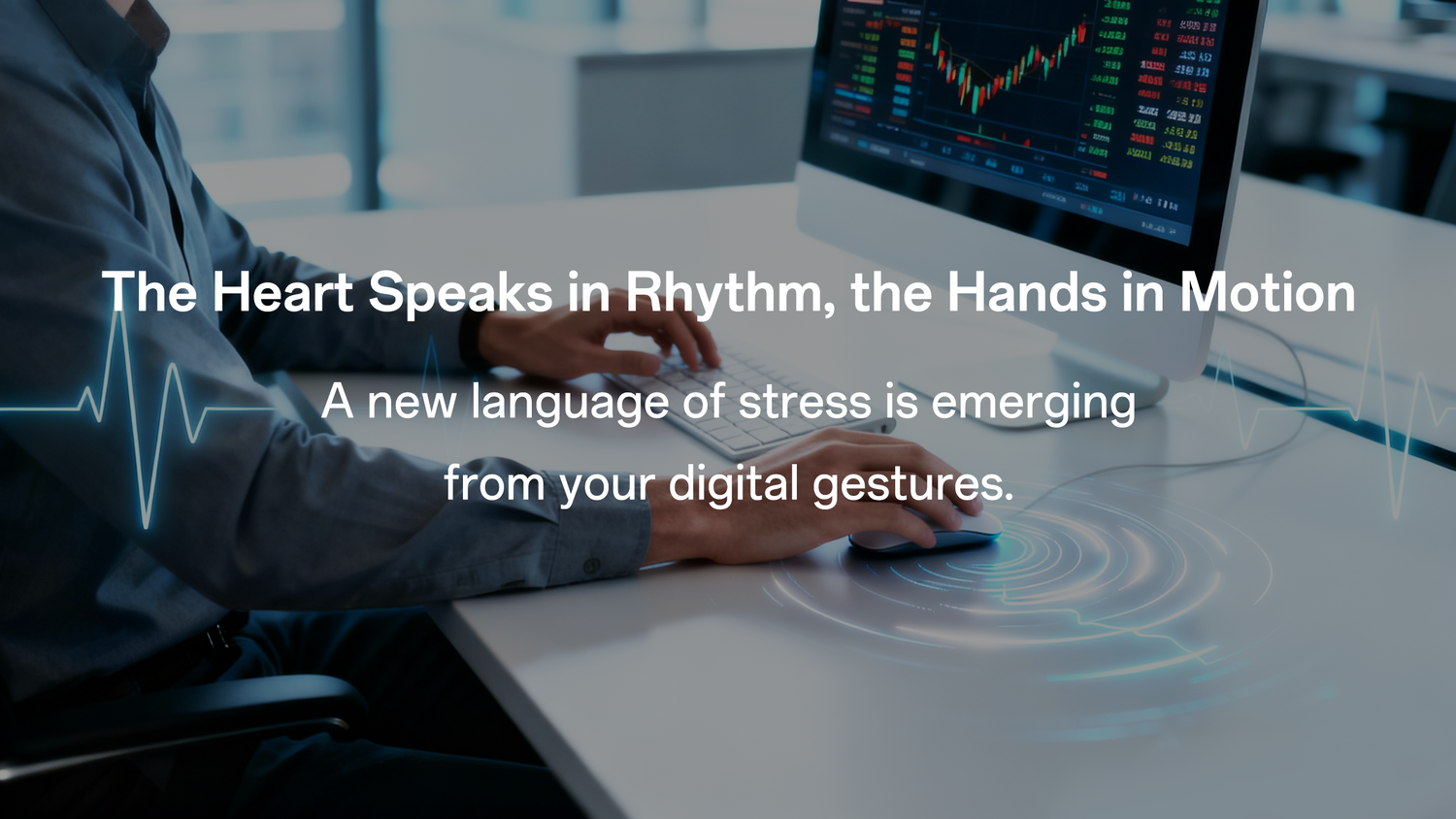
If Heart Rate Variability is the heart's echo of stress, the mouse and keyboard are the hands’ moment of hesitation. Both are speaking, but the latter proves more robustly honest in the reality of the working world.
Chapter I: Physiological Indicators’ Real-World Blind Spot
HRV is a well-established indicator of the stress response (Kim et al., 2018; LeBlanc et al., 2025). However, in the highly active environment of an office—where performance dictates the need for stress detection—HRV measurement faces inherent, nearly insurmountable hurdles related to data collection quality.
1.1 The Crisis of Motion Artifacts and Missing Data
The physiological foundation of HRV is inherently vulnerable to the very activities that define office work, particularly typing and movement.
- PPG Signal Contamination: Mechanical interference from typing severely degrades the signal required to calculate HRV metrics. Keyboard typing is identified as leading to a significant amount of artifacts in PPG-based measures (Naegelin et al., 2025).
- Massive Data Loss: This contamination translates directly into data loss. In an 8-week observational field study ($N=36$), participants had an average of 35.36% missing HRV feature data across their observations, which critically limited analysis (Naegelin et al., 2025).
- The Specificity Problem: The association between HRV and perceived stress appears weaker outside controlled environments, suggesting contextual modulation (Immanuel et al., 2023). The link is "not specific enough" in the field because HRV is easily confounded by physical movements and cognitive load (Tran et al., 2023).
1.2 The Implausibility of Universal Stress Models
The high inter-individual variability in stress response means that generalized models cannot reliably predict stress levels for unseen subjects.
- Negligible General Performance: The general "one-fits-all" modeling approach yields weak correlations with self-reported stress levels. The highest mean Spearman's $\rho$ achieved was only 0.078 for the standard approach, or 0.096 when incorporating time sequences, remaining in the negligible to low range (Naegelin et al., 2025,).
- Academics' Consensus: Given the weak performance, researchers argue that a general, one-fits-all model for stress detection might "never reach satisfactory results" under real-world conditions (Naegelin et al., 2025,).
Chapter II: M/K Behavior — The Robust Extension of Strain
When the heart falters in data fidelity, the hands quietly take over. The keyboard and mouse offer a robust layer of information by capturing the direct, functional outcome of the body’s internal strain, bypassing the noise that plagues physiological sensors in the workplace.
2.1 The Logic of Behavior: Why the Hand is a Reliable Speaker
M/K data is highly suited for stress detection in the office due to its accessibility and basis in neuroscience.
- Unobtrusive and Available: Mouse and keyboard usage data are considered some of the most suitable data sources for stress detection in office environments due to their unobtrusiveness, availability, and cost-effectiveness (Naegelin et al., 2025,). Participants rated M/K data as highly acceptable (Morshed et al., 2022).
- Theory of Neuromotor Noise: The scientific link is supported by the Neuromotor Noise Theory, which posits that stress increases the degree of "neuromotor noise"—a heightened variability in neural signals—leading to imprecise motor control and movement (Naegelin et al., 2025).
- Exposure through Accuracy Trade-off: Stress influences goal-directed actions, such as mouse movements, often resulting in a speed-accuracy trade-off (Naegelin et al., 2025).
2.2 The Digital Fingerprint of Pressure
The physical signature of pressure is recorded not in a deep physiological signal, but in the micro-hesitations of digital work, reflecting compromised motor control and attention.
| M/K Stress Feature Category | Key Indicator | Mechanism of Exposure |
|---|---|---|
| Mouse Trajectory | Direction Change Count; Distance; Speed-Accuracy Trade-off | Stress increases motor noise, forcing the user to over-correct or exhibit less precise movements. |
| Keystroke Dynamics | Key Pause Count (Pauses > 1s); Key Pause Duration Mean | Stress impairs attentional control, leading to cognitive "stalls" and interruptions in typing rhythm. |
| Data Scope | Models integrate up to 53 mouse features and 49 keyboard features (Naegelin et al., 2025,) | These features capture stress-related changes in motor noise and attentional control. |
What begins as a microscopic twitch of the finger soon becomes a measurable trace of the mind.
Chapter III: Data Hierarchy: M/K’s Robustness and HRV’s True Domain
The individualized nature of stress demands personalized models. In this crucial test of real-world applicability, M/K models proved superior in their consistency and robustness across the population sample.
3.1 Personalized M/K Models Demonstrate Higher Robustness
Personalized models, where data is used to train an individual model per participant, offer the only reliable way forward (Naegelin et al., 2025,).
- Overall Performance: Personalized XGBoost models trained on Mouse and Keyboard (MK) features achieved an average Spearman's $\rho$ of 0.188, slightly surpassing the pure HRV-based models (H models, $\rho=0.185$) (Naegelin et al., 2025). Optimized personalized approaches further improved to an average $\rho$ of 0.296 (Naegelin et al., 2025).
- Consistency Across Users: The most compelling evidence for M/K's robustness is its broad applicability. The MK model outperformed the randomized baseline for 19 out of 36 participants, demonstrating its potential effectiveness for the majority of users. In sharp contrast, the HRV-based (H) model achieved this threshold for only 6 out of 32 participants (Naegelin et al., 2025).
- Complementary Value: This suggests that while HRV signals may be sensitive, their utility is compromised by low data quality in active settings, making the more reliable M/K signal the preferred metric for active work states (Naegelin et al., 2025).
Yet robustness alone does not crown a new king—HRV still reigns in its rightful domain.
3.2 HRV’s True Domain and the Necessity of Multimodal Views
HRV's scientific validity is not diminished; rather, its strength is confirmed in controlled or low-activity settings, emphasizing its role as a necessary complement.
- Controlled Environment Validation: In simulated clinical settings, time-domain HRV parameters (RMSSD, SDNN, PNN50) accurately differentiated between rest and stress periods ($\eta^2$ values of 0.43 to 0.70, all $p<0.01$), and showed strong correlations with objective measures like salivary cortisol ($r=-0.54$ to $-0.63$, all $p<0.01$) (LeBlanc et al., 2025,).
- The Metric Discrepancy: The challenge is compounded by inconsistencies in software. One study found that while time-domain HRV parameters were highly correlated between a mobile application and reference software ($r > 0.92, p < 0.001$), the frequently reported LF/HF ratio showed a low and non-significant correlation ($r=0.10, p=0.58$), suggesting high variability in proprietary calculation algorithms (LeBlanc et al., 2025).
- The Ultimate Insight: While HRV-based models achieved the highest scores for some participants (Naegelin et al., 2025,), this indicates that underlying individual differences and physiological dispositions can affect the degree of correspondence between physiological and psychological measures (Naegelin et al., 2025). The stress response is complex and involves multiple systems (LeBlanc et al., 2025). Psychological stress responses, such as self-report, function over varying time periods and are affected by different moderating factors. These factors, which can be challenging to control in naturalistic settings, necessitate a multimodal approach (LeBlanc et al., 2025,).
Chapter IV: Personal Empowerment: From "Being Tracked" to "Self-Adjustment"
The integration of M/K data into personalized models provides a novel, low-cost solution for enhancing self-awareness and enabling proactive stress intervention.
4.1 How to Decode Your Digital Fingerprint
Your M/K behavior exposes the functional strain on your nervous system, allowing you to recognize stress cues before they become overwhelming.
- Exposure Mechanism (What): Your actions reveal stress-induced neuromotor inefficiency—the visible result of "noise" in your system (Naegelin et al., 2025).
- Self-Correction Cues (How): The signs are measurable: frequent directional changes in mouse movement signal uncertainty and repeated corrections; long and frequent typing pauses indicate cognitive stalls and attention deficits (Naegelin et al., 2025,).
- Personalized Requirement: Generic, one-size-fits-all models are ineffective (Spearman's $\rho \approx 0.078$) (Naegelin et al., 2025). Only by building a personalized baseline—based on your unique M/K data—can you gain a reliable predictor of your perceived stress level (Naegelin et al., 2025).
4.2 The M/K Value: A Reality-Based Complement
Readers should view M/K data not as a competitor, but as the essential "reality-based school" for the more sensitive, but noise-prone, HRV data.
- M/K as a Proxy: M/K provides a highly robust measure of strain during the active work phase where HRV is compromised by motion artifacts (Naegelin et al., 2025).
- HRV as a Recovery Metric: Conversely, HRV remains the gold standard for measuring vagal tone during periods of rest or controlled activity, providing crucial data on long-term resilience and recovery (Immanuel et al., 2023).
Conclusion: The Path to Robust, Personalized Self-Awareness
The evidence supports that reliably detecting perceived stress in naturalistic settings remains an open challenge (Naegelin et al., 2025; Booth et al., 2022). However, the shift toward personalized systems that prioritize robustness in the face of real-world noise offers a clear strategy.
The M/K behavior signal, due to its inherent availability and resistance to physiological motion artifacts in the office, provides a more reliable foundation for stress prediction than HRV data alone in this context (Naegelin et al., 2025). Future research must focus on integrating multimodal data—leveraging M/K for active strain and HRV for underlying resilience—through rigorous ML procedures that account for temporal heterogeneity (Naegelin et al., 2025).
In the end, our stress is never silent—it just changes its language. The heart speaks in rhythm, the hands in motion. Learning to listen to both may be the truest form of self-awareness the digital age has to offer.


Hinterlasse einen Kommentar
Diese Website ist durch hCaptcha geschützt und es gelten die allgemeinen Geschäftsbedingungen und Datenschutzbestimmungen von hCaptcha.