

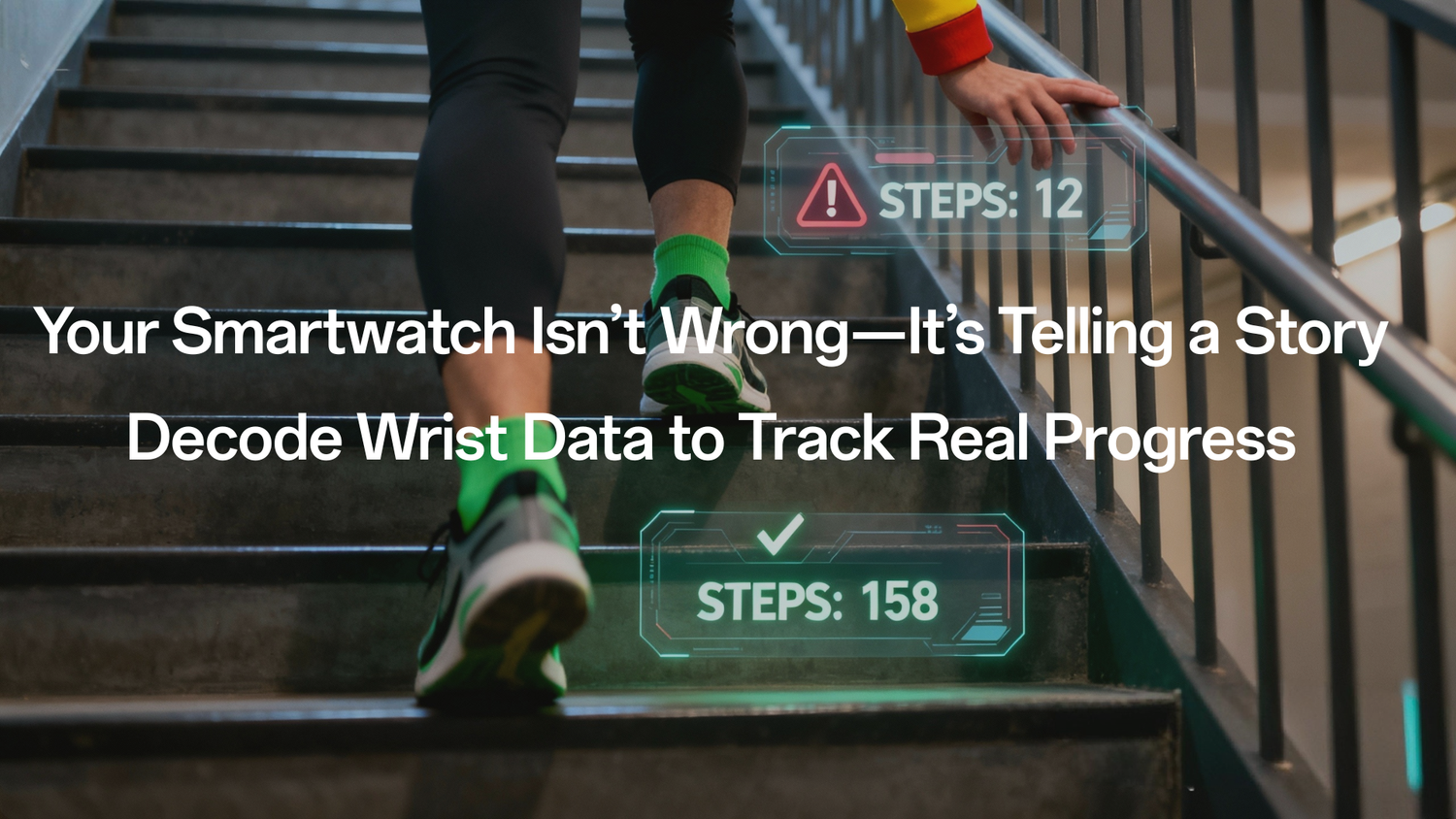
Imagine you are running up a flight of stairs, powering through your workout, only to check your wrist and see a strangely low step count. Did your smartwatch fail? Not exactly. It simply adhered to a predictable physical pattern—one that reveals as much about the device’s working principle as it does about your actual activity.
For millions, the wrist-worn smartwatch is the indispensable tool for tracking progress toward the goal of 10,000 steps. Yet, validation studies consistently show that this convenient placement is often the least accurate for step counting.
Our goal is not to "call out" these devices. Instead, we must recognize that the observed differences are not random errors, but systematic patterns that can be understood and utilized. By learning the rules of "wrist deviation," we can transform our smartwatch from a simple recorder into a highly effective, personalized health coach.
Chapter 1: Revealing the Engine’s Rules—Why the Wrist Creates Predictable Deviation
Let's be honest: the wrist is the easiest place to wear a tracker. But the sensors inside, based on accelerometers, measure the motion of your arm, not the ground contact of your foot. This physical distance creates inevitable deviations, which are highly context-dependent.
1.1 The Inherent Precision Hierarchy
Scientific evaluation consistently confirms a fundamental hierarchy of measurement: the closer the device is to the center of mass or the point of movement, the lower the measured deviation.
- The Midsole Advantage: In structured activities like walking, running, and stair climbing, research finds that the midsole-worn pedometer provides the highest accuracy, followed by waist-worn and then wrist-worn pedometers.
- The Precision Gap: During walking, the wrist-worn pedometer presented significantly greater error scores when compared to the midsole-worn pedometer ($p < 0.001$). This deviation exists because the algorithms are designed to track rhythmic locomotion, and the wrist's movement profile during normal walking is far less stable than the foot's.
- Reliability Follows Accuracy: This pattern holds true even for reliability (consistency). For complex vertical activities like stair climbing, only the midsole-worn pedometer showed acceptable reliability. This shows that in situations demanding high-fidelity movement tracking, the wrist placement is fundamentally disadvantaged.
So next time your tracker seems low during a rigorous workout—maybe it’s not wrong, just revealing its context. The highest fidelity signal is simply happening elsewhere.
Chapter 2: The Self-Calibration Toolkit—Mastering Context-Aware Tracking
The most effective users don't aim for absolute perfection; they look for systematic patterns and adjust their interpretation accordingly. Here is how to decode your watch's predictable deviations in two common scenarios.
2.1 Pattern A: When the Device Sees Too Little (Systematic Undercounting)
The wrist tends to undercount steps when the rhythmic arm swing necessary for detection is reduced or absent.
| Contextual Factor | Deviation Pattern | Actionable Strategy | Citation |
|---|---|---|---|
| Fixed Arms | Device significantly undercounts steps (e.g., pushing a stroller or holding treadmill bars). This is especially true if the fixed object contacts the floor. | Know the Loss Rate: Be aware that your step total is dramatically lower than reality. During these moments, track your Heart Rate (HR) instead, as studies show smartwatches maintain excellent HR accuracy at rest and recovery (error $\leq 3%$). | |
| Low Walking Speed | Device performance is generally lowest at slow walking speeds. The arm swing may not be pronounced enough to reach the algorithm's minimum threshold. | Segment Your Day: If you are a slow walker or patient population (CVD/PAD), know that your true activity is likely higher than reported. For periods requiring high accuracy (like rehabilitation), consider specialized devices worn on the leg or hip. | |
| Specific Activity | Low-cost smartwatches severely underestimated manually counted steps during a 3-Minute Walk Test and Stair Climbing (SC) ($p=0.009$; $p=0.012$). | Trust the Trend: Use step counting for trend analysis and motivation, not critical diagnostics. |
2.2 Pattern B: When the Device Sees Too Much (Systematic Overcounting)
Conversely, when the arm is active but the body is stationary, the wrist-worn device tends to overcount steps.
- The "Ghost Step" Phenomenon: In free-living conditions (e.g., cooking, cleaning, or emphatic gesturing), the wrist device may record steps that were not actually taken. One validation study using the Huawei Watch GT2 found the device overestimated Step Count (SC) when compared to a reference accelerometer worn on the hip.
- Utilizing Hand Dominance: This overcounting reveals a simple correction mechanism. Studies have found that step estimates differed significantly based on which wrist wore the monitor, with the dominant wrist yielding greater step estimates. This predictable deviation on the dominant hand is likely due to increased activity (such as daily tasks).
- Actionable Insight: By consistently wearing your smartwatch on your non-dominant wrist, you immediately filter out a high proportion of this "ghost step" noise, improving data consistency across your week.
Chapter 3: Beyond the Count—Harnessing Data for Clinically Meaningful Progress
The true value of wrist data is realized not in its raw numerical perfection, but in its ability to facilitate behavior change and its capacity to measure progress against clinically relevant standards.
3.1 The Motivational Multiplier
The most consistent scientific finding is that simply using these devices works. Pedometers and activity trackers are strongly associated with increases in physical activity.
- Behavioral Change is Real: Systematic reviews confirm that using pedometers can lead to an increase in physical activity by more than 2,000 steps per day when individuals aim for a goal.
- Self-Awareness Calibration: Furthermore, the regular counting and reporting of daily steps significantly improves the subjective estimation accuracy of an individual’s daily step count, an effect that remains stable for at least 6 weeks. The device, therefore, acts as a powerful feedback loop, training your brain to better understand your body’s activity level.
3.2 Speaking the Language of Clinical Significance (MCID)
For users committed to recovery or serious training, the question shifts from "How many steps did I take?" to "How much must I improve for that change to matter?"
In other words, the numbers on your wrist can speak the same language as your clinician—if you know how to listen.
This is where the concept of the Minimal Clinically Important Difference (MCID) becomes central. The MCID is the smallest change in a measured parameter that is considered truly meaningful from a patient's or clinician's perspective. Recent studies have quantified this exact threshold using consumer smartwatches in neurological populations.
- Measuring Meaningful Change (PD Example): Research calculating the MCID for average daily steps (avDS) in mild-to-moderate Parkinson Disease (PD) established distinct goals:
| Goal of Intervention | Required avDS Increase per Day | Percentage of Average Daily Steps |
|---|---|---|
| Subtle Mobility Improvement | Approx. 581 steps/day | $\sim 10%$ |
| Improved Clinical/Health Status | Approx. 1,200 steps/day | $\sim 20%$ |
| Improved Patient-Reported Quality of Life (PROs) | Approx. 1,592 steps/day | $\sim 27%$ |
This framework provides highly actionable targets. For example, if a PD intervention aims to subtly improve motor function, the target is 581 steps/day. Conversely, if the goal is perceived improvement in quality of life, a larger target (1,592 steps/day) is required. Achieving these changes is feasible; previous interventions have successfully increased activity by 763 to 1,250 steps/day.
The key takeaway here is that you must achieve a change that exceeds the device’s own measurement variability (Minimum Detectable Change, MDC) to ensure the change is scientifically sound. The difference between 581 steps (meaningful improvement) and a device’s typical Measurement Deviation is the difference between genuine progress and noise.
Conclusion: The Intelligent Dialogue
The journey with a smartwatch requires a shift in perspective. The goal isn’t perfect tracking. It’s a more intelligent dialogue between you and your data—one that turns imperfection into understanding.
The predictable deviation of your wrist device is not a failure; it is contextual information, urging you to become a smarter user. By applying the principles derived from validation studies—standardizing your wear location to the non-dominant wrist, understanding the low-speed threshold, and comparing your progress against clinical MCID values—you move beyond merely counting steps. You begin to monitor meaningful, sustained behavior change.
The smartwatch remains a powerful accessory in the quest for health. But when you learn to read between the lines, acknowledging where the wrist’s signal is strong and where it is context-limited, you finally unlock its full potential.

Leave a comment
This site is protected by hCaptcha and the hCaptcha Privacy Policy and Terms of Service apply.