

Introduction: The Paradox of Precision
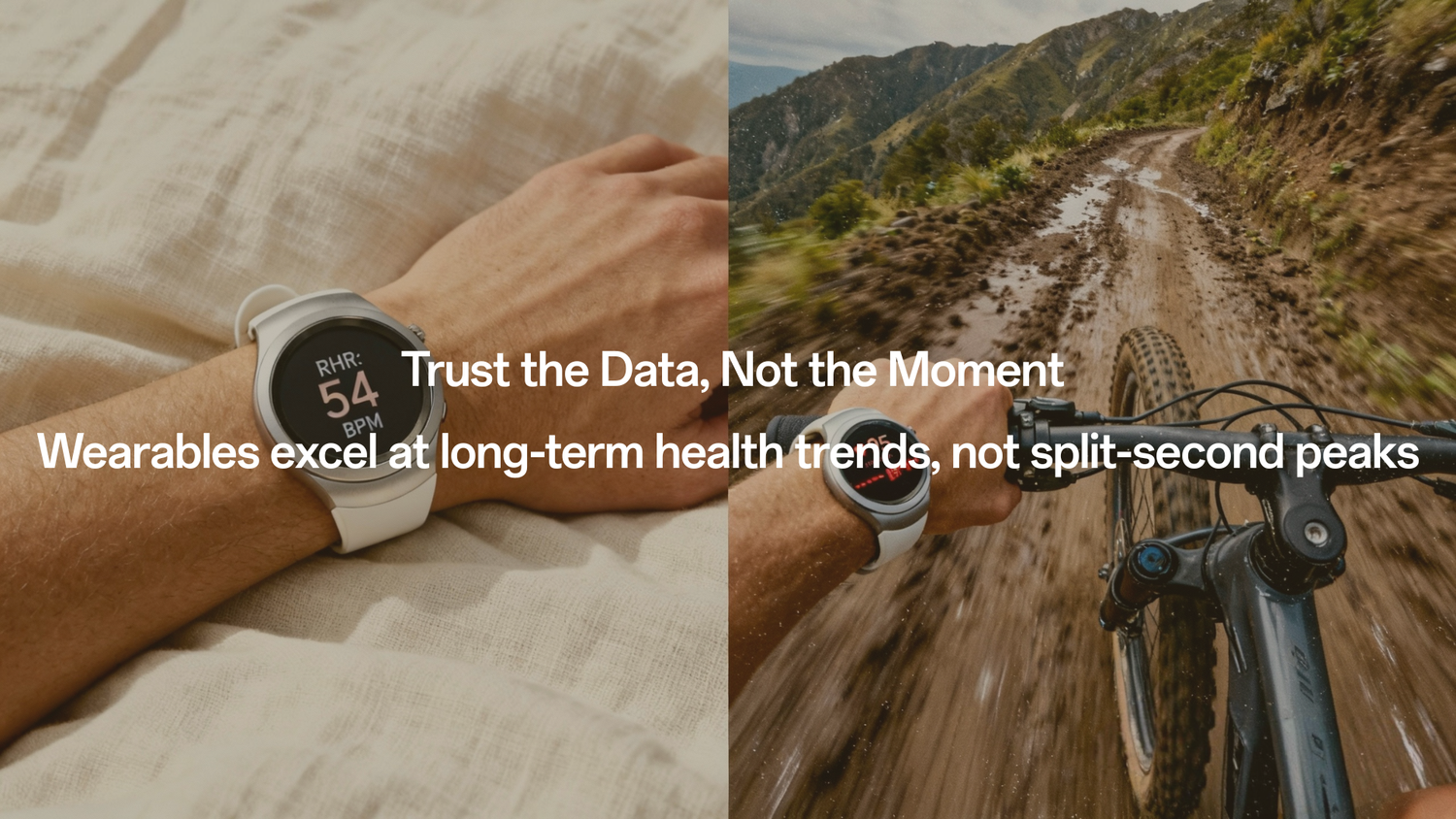
The journey with a consumer wearable often begins in frustration—a furious sprint where the device reports a lagging, nonsensical heart rate (HR) peak. This common struggle leads many to question the reliability of their health companion altogether. Yet, this skepticism misses the profound scientific truth: wearable devices do not fail us; they simply thrive under radically different conditions.
While optical sensors may struggle with the chaos of daytime movement, they transform into sophisticated "Data Kings" when the body is at rest. The stillness of sleep eliminates their greatest technical vulnerability, enabling a level of accuracy and long-term relevance that fundamentally reshapes personal health monitoring. This analysis confirms that the device's true power lies not in tracking your highest workout effort, but in faithfully recording your deepest rest.
I: The Technical Silence: Why Stillness Is PPG's Superpower
The performance gap between day and night is rooted in the core technology of most wearables: Photoplethysmography (PPG). PPG uses light to measure subtle changes in peripheral blood volume, a process that is highly susceptible to external interference.
I.1. Eradicating the Motion Artifact: The Sensor's Focus
The Achilles' heel of PPG during the day is the motion artifact—any physical movement that corrupts the light signal as the sensor shifts on the skin.
In contrast, the stationary state of rest and sleep eliminates the vast majority of this movement-induced noise. This provides the optical sensor with a near-perfect environment, allowing it to capture the subtle physiological signals with high fidelity. PPG technology has been well validated during resting and sleep conditions.
Think of it as trying to take a clear photo in the dark—any slight movement blurs the image. Stillness lets the sensor 'focus.'
This reality is supported by studies on specialized populations. Research on children with heart disease found that HR measurement accuracy for wearables was significantly higher during sleep time (ranging from $\mathbf{90.1%}$ to $\mathbf{90.8%}$ accuracy) compared to wake time (ranging from $\mathbf{82.1%}$ to $\mathbf{86.1%}$ accuracy) (Hardon et al., 2025, JMIR Form Res). This difference is directly linked to the effect of bodily movement on measurement accuracy (Hardon et al., 2025, JMIR Form Res).
I.2. Data Processing and Trend Reliability
Wearables are largely better suited for average and trend HR monitoring than capturing acute dynamics (Van Oost et al., 2025, Sensors). The stability afforded by a full night’s sleep naturally favors this algorithmic approach.
Larger averaging windows are consistently shown to improve accuracy by smoothing variability (Van Oost et al., 2025, Sensors). In the nighttime, where physiological changes are minimal, this aggregation aligns perfectly with the stable signals, resulting in highly reliable trend data. However, it is important to note that the sampling frequency and data processing methods for most consumer-grade devices remain proprietary and are not publicly disclosed (Van Oost et al., 2025, Sensors).
In short, motion kills precision—but stillness resurrects it.
II: The Crown Jewels of Nightly Data: RHR and HRV Precision
With motion artifacts suppressed, the device becomes highly competent at measuring two of the most valuable physiological biomarkers: Resting Heart Rate (RHR) and Heart Rate Variability (HRV).
II.1. RHR: Achieving Clinical-Grade Stability
RHR is a crucial metric, as a chronically elevated RHR is recognized as a strong, independent risk factor for cardiovascular disease (Palatini, 2007; Fox et al., 2007).
Validation studies confirm that nocturnal RHR accuracy is exceptionally high compared to the ECG reference:
- Near-Perfect Agreement: Ring-based devices demonstrated the highest accuracy, with one brand showing RHR Lin's Concordance Correlation Coefficient (CCC) of $\mathbf{0.97}$ (Dial et al., 2025, Physiological Reports) and $\mathbf{0.98}$ (Dial et al., 2025, Physiological Reports) for two different generations.
- Clinically Negligible Error: For these high-performing devices, the Mean Absolute Percentage Error (MAPE) was extremely low: $\mathbf{1.67% \pm 1.54%}$ (Dial et al., 2025, Physiological Reports) and $\mathbf{1.94% \pm 2.51%}$ (Dial et al., 2025, Physiological Reports). This minimal error is often considered clinically irrelevant, as RHR deviations typically need to reach $\mathbf{5}$ to $\mathbf{7 \text{ bpm}}$ or $\mathbf{10%}$ of baseline to be clinically meaningful (Nanchen, 2018; Vazir et al., 2018).
The implications are profound: If a clinician or user is interested in tracking the long-term trend of RHR—the metric most strongly linked to future health outcomes—the nocturnal data provided by high-performing wearables is highly trustworthy.
II.2. HRV: Deciphering Recovery and Stress
HRV reflects the activity of the autonomic nervous system (ANS) and is key to assessing stress and recovery (Shaffer & Ginsberg, 2017). The stable state of sleep allows for the most accurate calculation of this sensitive metric.
- Maximized HRV Accuracy: High-performing devices achieved a CCC of $\mathbf{0.99}$ for HRV (Dial et al., 2025, Physiological Reports), with a MAPE of just $\mathbf{5.96% \pm 5.12%}$ (Dial et al., 2025, Physiological Reports).
- Actionable Intelligence: This validity means that the recovery scores or readiness metrics provided by these devices are rooted in solid physiological data (Dial et al., 2025, Physiological Reports). These systems are integral to providing actionable insights into chronic stress and sleep disorders (Bayoumy et al., 2021; Hickey et al., 2021).
III: Beyond the Beat: The Multi-Sensor Advantage of Rest
Let’s zoom out: beyond the heart, what else does the night reveal? The stable environment allows wearables to integrate multiple sensors and validate numerous other crucial physiological parameters.
III.1. Expanding Metrics Through Signal Analysis
The stillness facilitates the analysis of subtle signal changes derived from PPG or ECG:
- Respiratory Rate (RR): RR can be estimated by analyzing the subtle variations in the PPG or ECG signals (Charlton et al., 2017, IEEE Rev. Biomed. Eng.). Tracking nocturnal average respiratory rate has significant clinical relevance, as mean nocturnal RR predicts cardiovascular and all-cause mortality in older adults (Baumert et al., 2019, Eur. Resp. J.).
- RR Accuracy in Sleep: The accuracy of respiratory rate estimation during sleep has been validated. For patients with normal-to-moderate Obstructive Sleep Apnoea (OSA), average overnight respiratory rate measurements using one consumer watch were at least $\mathbf{90%}$ accurate (Jung et al., 2023, Sensors, citing reference 62). The root mean squared error (RMSE) for the average overnight RR was $\mathbf{1.13 \text{ bpm}}$ (Jung et al., 2023, Sensors, citing reference 62).
- Sleep Stage Classification: Devices estimate sleep staging by combining PPG sensors with accelerometers (Birrer et al., 2024, npj Digital Med.).
III.2. Enabling Advanced Diagnostics
The stable, static environment enables advanced clinical functions that are impractical or impossible during movement:
- Arrhythmia Screening: Smartwatches with ECG capabilities can detect increased risk for conditions like Atrial Fibrillation (AF) (Jamieson et al., 2025, npj Cardiovasc Health; Perez et al., 2019, N. Engl. J. Med.). Furthermore, portable ECG devices have been approved for pre-diagnostic detection of AF (Belani et al., 2021, Cureus).
- Body Composition (BioZ): Some consumer devices integrate Bioimpedance Analysis (BioZ) technology to estimate body composition metrics (Mehra et al., 2024, Nutrition). This measurement is typically performed during quiet, resting moments (Samsung, 2025). BioZ may also be used in conjunction with ECG sensors to predict heart failure decompensation (Giménez-Miranda et al., 2024, Rev. Cardiovascular Med.).
IV: The Boundaries of Precision: Navigating Conditional Accuracy
Even at their peak performance—during sleep—wearables remain complex data systems. Understanding the conditional accuracy of the device—the factors that influence data quality even when static—is what allows us to trust the data intelligently.
IV.1. The Critical Role of Wearing Position
The optimal signal quality in a static state is heavily dependent on the device's physical location and fit.
- Positioning Matters at Rest: Studies analyzing nocturnal monitoring consistently found that ring-based devices (CCC $\mathbf{0.97}$ to $\mathbf{0.98}$) demonstrated the highest consistency and lowest error for RHR and HRV (Dial et al., 2025, Physiological Reports). This superior performance often positions finger-worn devices above wrist-worn devices, such as one wrist-worn model with a RHR CCC of $\mathbf{0.91}$ (Dial et al., 2025, Physiological Reports).
- Clinical启示: This hierarchy confirms that choosing a stable position, such as the finger, is crucial for maximizing performance, especially when monitoring highly sensitive metrics like HRV.
IV.2. Algorithms, Generalizability, and Rational Trust
Intelligent trust in wearable data requires acknowledging the ongoing evolution and existing limitations in clinical generalizability.
- Evolutionary Algorithms: All commercial devices utilize proprietary algorithms to filter noise and calculate metrics like RHR and HRV (Dial et al., 2025, Physiological Reports). These algorithms may be updated periodically, potentially altering how RHR or HRV are calculated (Dial et al., 2025, Physiological Reports).
- Need for Continuous Validation: Since algorithms and hardware undergo continuous updates, frequent evaluation of their validity should continue (Dial et al., 2025, Physiological Reports).
- Generalizability Limitations: Most high-accuracy validation studies are performed on apparently healthy adults (Dial et al., 2025, Physiological Reports). The generalizability of these high scores should be considered when applying the data to individuals with severe sleep or cardiovascular disorders. For instance, Atrial Fibrillation (AF) interferes with normal heart rhythms and thus impacts HRV readings (Chen et al., 2006; Mccraty & Shaffer, 2015). Furthermore, RR accuracy decreases for patients with severe OSA (down to $\mathbf{79.5%}$ accuracy) (Jung et al., 2023, Sensors, citing reference 62).
Understanding these boundaries isn't skepticism; it’s what allows us to trust the data intelligently.
Conclusion: The Long-Term Health Historian
The evidence is clear: the most valuable, reliable data produced by a consumer wearable is generated during the deep silence of the night. By effectively eliminating the PPG sensor's primary obstacle—motion artifacts—the device’s accuracy for critical metrics like RHR and HRV is confirmed, placing the data comfortably within clinical acceptance thresholds (Dial et al., 2025, Physiological Reports). This nocturnal precision empowers the user with profound, continuous insights into cardiovascular health, stress recovery, and long-term trends (Bayoumy et al., 2021).
In other words, wearables don’t fail us—they simply tell a different kind of truth.
The device is an unparalleled historian of your deepest biological recovery. To harness the full potential of this technology, trust your wrist-worn monitor as the Data King of your long-term health story, focusing on the stable, clinically relevant metrics established in the stillness of the night.


Leave a comment
This site is protected by hCaptcha and the hCaptcha Privacy Policy and Terms of Service apply.