

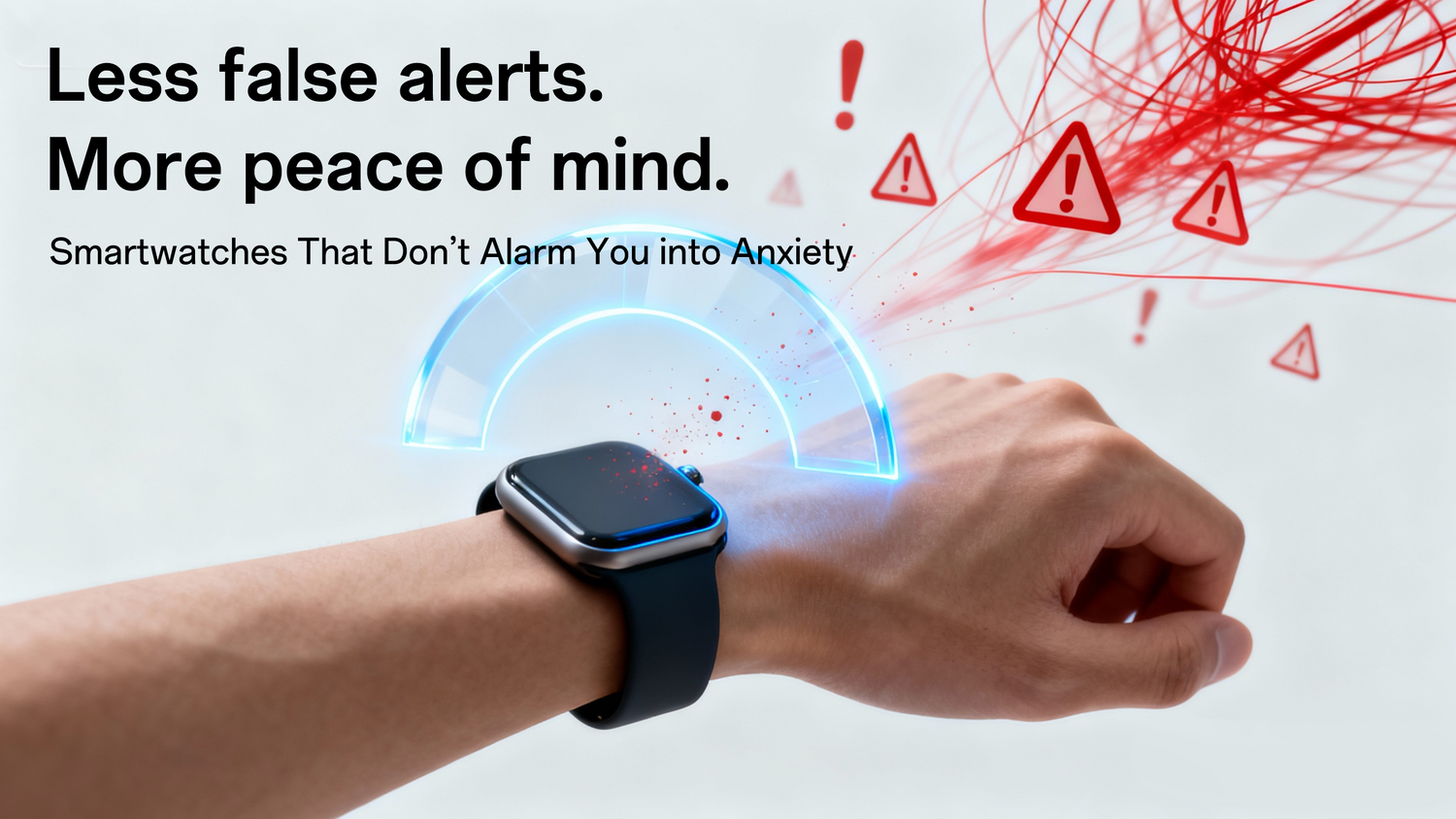
Introduction: The Paradox of Perpetual Vigilance
The proliferation of consumer smartwatches has moved continuous physiological monitoring from the ICU bedside to the wrists of millions. Yet this accessibility has revealed a critical paradox: the pursuit of maximum detection sensitivity—to “never miss an event”—inevitably leads to false alarms. That noise carries measurable human and societal costs, threatening the very trust this technology seeks to earn (Ma et al., 2025, Nature).
The industry now faces an Awakening. Technological excellence alone is no longer enough; systems must learn to distinguish between life-saving information and intrusive distraction. The next frontier of innovation lies not in louder data, but in cultivating “Quieter Confidence.”
I. The Psychological and Social Cost of Over-Alerting
When health monitoring systems fail to filter noise effectively, the result is not harmless. False or exaggerated alerts impose tangible psychological strain on individuals—especially older adults—and can create cascading burdens across public health systems.
1. The Dose-Dependent Erosion of Individual Well-being
For elderly users at high cardiac risk, an unexpected alert can trigger deep anxiety. Evidence from the Pulsewatch clinical trial of older stroke survivors demonstrates this vividly: false atrial fibrillation (AF) alerts led to significant declines in self-reported physical health ($\beta = -7.53, P < 0.02$) (Tran et al., 2023, Cardiol Cardiovasc Med; Filippaios et al., 2022, Cardiovasc Digit Health J).
The effect was dose-dependent. Participants who received more than two false alerts experienced larger drops in both perceived physical well-being and confidence in managing chronic symptoms ($P = 0.001$ and $P = 0.002$) compared to those who received fewer alerts (Tran et al., 2023). In total, two-thirds (67%) of all alerts were ultimately false positives, underscoring the scale of the issue.
The implication is clear: future mHealth design must integrate psychological safety into its logic. A device that continuously provokes anxiety cannot, by definition, be considered “healthy.”
2. The Mandate to Preserve Public Resources
For rare, high-stakes emergencies such as Out-of-Hospital Cardiac Arrest (OHCA), the design stakes become societal. OHCA’s low incidence means that if a mass-market wearable lacks adequate specificity—the ability to correctly identify true negatives—it risks flooding emergency services with false activations (Shah et al., 2025, Nature).
This reality has established a new governing design principle: specificity must take precedence over sensitivity.
| Metric | Design Goal & Rationale |
|---|---|
| False Activation Rate | To be viable at scale, a device must minimize the societal cost of false alarms. |
| Specificity Validation | In two prospective free-living studies, only one unintentional emergency call per 21.67 user-years was recorded, achieving a day-level specificity of 99.987%. |
| Technical Constraint | Using only 5–10 seconds of pulse input—common in clinical settings—would cause an “extraordinarily high false-positive rate” on wrist-worn PPG devices. |
Source: Shah et al., 2025, Nature.
This disciplined trade-off—accepting some loss in sensitivity to safeguard public systems—marks the ethical maturation of always-on monitoring. The insight that made this possible was the discovery that PPG readings of pulselessness caused by Ventricular Fibrillation (VF) resemble those induced by peripheral arterial occlusion, allowing scalable simulation and validation in development (Shah et al., 2025).
II. The Architecture of Adaptive Trust: AI, Personalization, and Timeliness
Achieving “Quieter Confidence” requires more than clever algorithms—it demands a rethinking of trust itself. The industry’s technical awakening now focuses on intelligent personalization, real-time adaptability, and context-aware alerting that respects both the user’s biology and psychology.
1. Multidimensional Analysis for Personalized Baselines
Instead of relying on single-variable thresholds, modern anomaly detection builds a multidimensional physiological baseline unique to each user. Human physiology is dynamic—shaped by aging, medication, and everyday fluctuations (Rosca & Stancu, 2025).
The HADA (Health Anomaly Detection Algorithm) exemplifies this shift. It continuously monitors six core parameters and analyzes correlations among them to detect deviations meaningfully:
| HADA Monitored Parameters | Performance & Strategic Trade-off |
|---|---|
| Heart Rate (Average, Minimum, Maximum) | Sensitivity: 100% |
| Sleep Time (Deep vs. Superficial) | Accuracy: 98.5% |
| Activity (Number of Steps) | Strategic Trade-off: The model intentionally allows for extra alerts (false positives) to avoid missing critical events—prioritizing safety, particularly in elderly care. |
(Source: Rosca & Stancu, 2025, Applied Sciences)
This approach reframes “accuracy” as a contextual metric—measured not by silence or volume, but by how precisely a device aligns with the user’s own physiological logic.
2. Model Adaptability and Real-Time Intervention
Personalization must evolve continuously. AI models are not static classifiers but living systems, retrained regularly to reflect physiological change.
-
Adaptive Learning: Models like HADA are periodically retrained per individual to accommodate natural variations. A hip fracture, for example, alters daily activity so drastically that failing to adapt would distort all subsequent readings (Rosca & Stancu, 2025).
-
Predictive Insight: Personalized anomaly detection can identify subtle early shifts—such as physiological signs preceding the elimination of kidney stones—long before medical escalation is required (Rosca & Stancu, 2025).
-
Low-Latency Infrastructure: Integrated with Azure cloud architecture, these systems can convert anomalies into actionable alerts within 11 seconds on average. Advanced hybrid models such as Ensemble LSTM-CNN achieve a 95% anomaly detection rate with a 2.5-second response time (Gayathri et al., 2024).
Together, these innovations move the field toward adaptive trust—where AI doesn’t just observe, but learns to communicate with precision and empathy.
Conclusion: The Triumph of Ethical Accuracy
The industry’s awakening signals a profound shift: true progress lies not in detecting everything, but in discerning what matters. Ethical accuracy—anchored in psychological insight and responsible design—has proven both clinically effective and economically sustainable.
Remote monitoring systems grounded in high specificity and continuous personalization have been shown to reduce unexpected hospital visits by about 15% (Leenen et al., 2023, JMIR Perioper. Med., cited in Rosca & Stancu, 2025). This marks the tangible reward of restraint: quieter systems that deliver measurable public benefit.
By denoising signal artifacts, refining baselines, and maintaining hyper-specific alert thresholds, smart wearables are finally evolving from noisy overseers to trustworthy companions. The most valuable alert, after all, is not the loudest—but the one that speaks through quieter confidence.


Dejar un comentario
Este sitio está protegido por hCaptcha y se aplican la Política de privacidad de hCaptcha y los Términos del servicio.