


Introduction: The Paradox of the Perpetual Monitor
The high-stakes world of healthcare relies on continuous technological vigilance—patient monitors tracking every subtle vital sign fluctuation. Yet, this very ecosystem, designed to ensure safety, generates profound stress, contributing significantly to professional burnout. In the last decade, smartwatches have emerged not merely as consumer accessories but as essential individualized digital intervention tools capable of addressing deep-seated issues concerning well-being and operational efficiency within medicine.
This analysis argues that wearable technology provides an indispensable strategy for reducing the professional burden on medical staff. The empirical evidence demonstrates that these devices both enhance personal resilience and systematically optimize high-risk clinical workflows. We will examine how this technology delivers a dual benefit, and how the inherent challenge of misinformation is being rigorously addressed by advanced Artificial Intelligence (AI) to establish a sustainable framework of digital trust.
I. The Crisis of Compassion: Quantifying and Sustaining Physician Resilience
Physician burnout is a pervasive occupational phenomenon resulting from chronic, high levels of work stress, severely threatening patient safety and system cost. While large-scale organizational reforms are crucial, the sheer convenience of smartwatches provides a powerful, individualized strategy to empower physicians to reclaim a degree of self-awareness and control over their health indicators.
1.1 Personalized Data as a Buffer Against Burnout
Wearable technology offers quantitative measures of physiological functioning, such as heart rate, sleep cycles, and physical activity. The premise is that individualized access to these metrics encourages stress-reducing behaviors and promotes greater self-regulation and agency—key components long associated with better well-being.
A multisite, peer-reviewed randomized clinical trial (RCT) involving 184 physicians evaluated the effect of accessing smartwatch physiological data over six months (Dyrbye et al., JAMA Network Open, 2025):
- Reduction in Burnout Risk: Physicians in the intervention arm experienced a 54.0% reduction in the odds of overall burnout (Odds ratio, 0.46; $P = .046$).
- Resilience Enhancement: The same group demonstrated a statistically significant increase in mean resilience scores, improving by 1.20 points on the 0-40 scale (Parameter estimate; $P = .03$).
This intervention did not lead to statistically significant global improvements in stress, depression, or overall quality of life, suggesting a targeted effect specifically on burnout and resilience. By providing objective feedback, the watch serves as a highly personal mirror, allowing the chronically stressed clinician to recognize patterns in their behavior and engage more frequently in actions that mitigate stress before the risk of personal suffering or negative impact to patient care occurs.
Reflective Meta-Line: This research shows the smartwatch provides not just metrics, but a mirror, allowing the highly stressed clinician to reclaim a degree of self-awareness essential for survival in a demanding profession. This personal victory must now be translated into organizational efficiency.
II. Clinical Workflow Revolution: A Measurable End to Alarm Fatigue
In the Intensive Care Unit (ICU), every beep carries moral weight. Each alarm could mean a life—or nothing at all. For nurses and physicians, this endless chorus of sound, often documented at more than 700 alerts per patient per day in studies, defines the rhythm of their workday. This constant barrage leads to severe alarm fatigue, causing staff desensitization and risking delayed response to genuine emergencies.
2.1 Smartwatches Systematically Filter Noise and Streamline Response
To counter this organizational stressor, smartwatches were introduced to nursing staff in an ICU setting to serve as an intelligent alarm management tool, distributing alerts in a coordinated, hierarchical manner. This solution directly addresses staff workload and stress.
A retrospective cross-sectional study conducted at a 27-bed ICU tracked the impact of this intervention (Ma et al., Nature, 2025):
- Total Alarm Load Reduction: The use of smartwatches significantly reduced the overall noise level, dropping the average alarm count from 295 alerts per bed per day (control) to 214.5 alerts (smartwatch group). This reduction in technical and low-level alerts lightens the general workload.
- Critical Response Improvement: By filtering the unnecessary chatter, the system achieved a significant improvement in the ability of staff to respond to life-threatening events. The proportion of fatal and high-risk alarms that were responded to within 30 seconds increased from 51.51% to 60.04% ($P < 0.0001$).
The improvement in response time is the critical metric: it indicates that the technology successfully directed attention away from non-critical issues (like technical alarms, which made up 60.37% of alarms in the intervention group) and toward high-priority events. Furthermore, the study noted that the utilization of smartwatches was associated with reduced durations of mechanical ventilation and ICU stays, signifying improved clinical outcomes derived directly from improved workflow efficiency.
Reflective Meta-Line: By systematically filtering the noise, smartwatches transform a chaotic environment into a targeted workflow, ensuring the vigilance of human staff is preserved for the moments that truly carry moral weight.
III. Digital Trust and Precision: AI Reduces Misinformation and Cognitive Burden
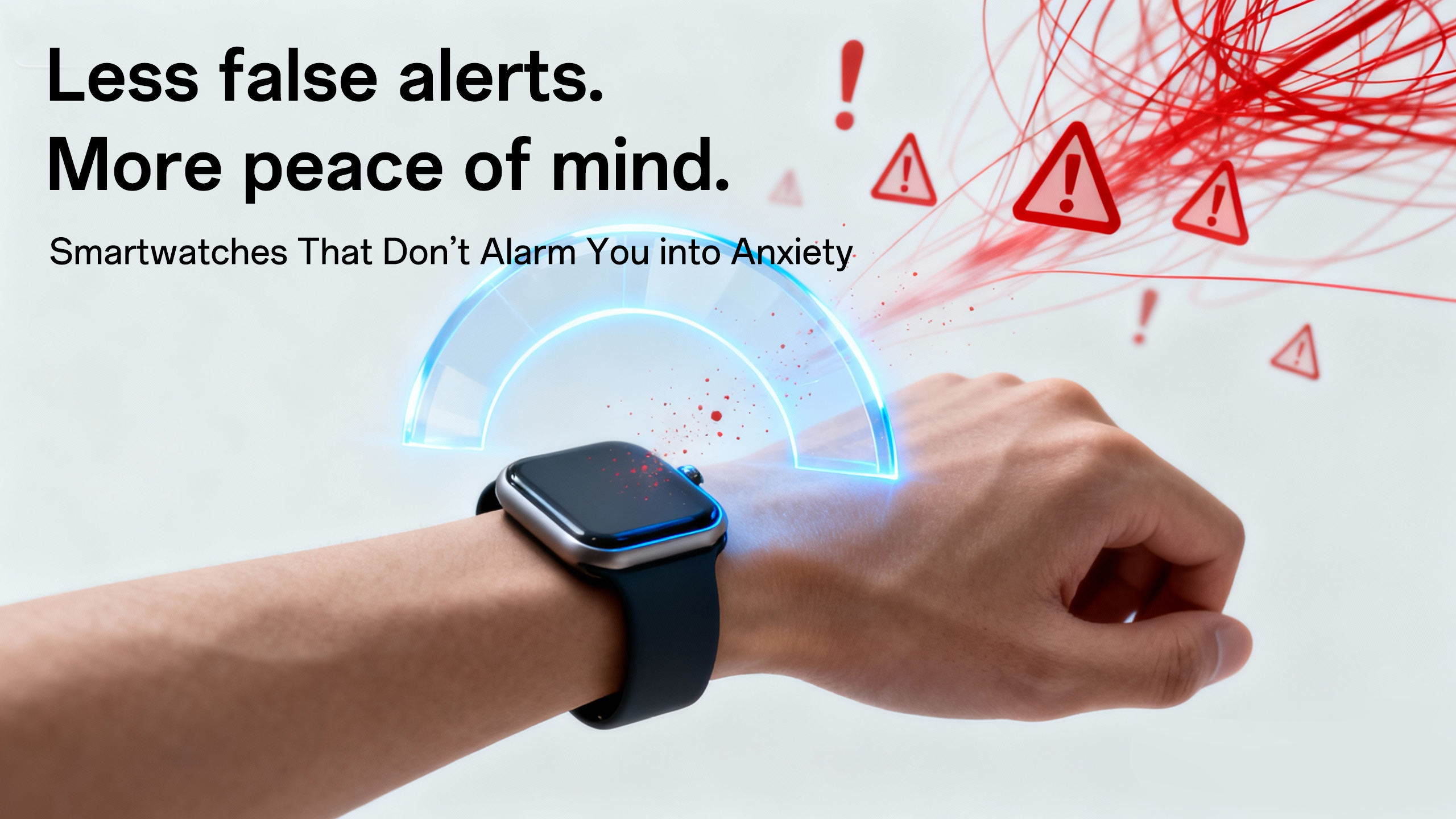
The core vulnerability of any continuous monitoring system is the inevitable false positive (misinformation). For medical professionals, every erroneous alert is a challenge to their finite attention and the system’s legitimacy. If a patient is alerted to a false abnormality, the ensuing anxiety and unnecessary contact create an unproductive cognitive load for the clinician.
3.1 The Cost of Falsehoods in the Patient-Clinician Dyad
Studies confirm that false alerts impose a psychological cost on the user, threatening the trust required for long-term monitoring. Specifically, in a study of older stroke survivors, receiving false Atrial Fibrillation (AF) alerts led to:
- A statistically significant decline in self-reported physical health ($\beta = -7.53, P = <0.02$).
- A decrease in confidence in chronic symptom self-management ($\beta = -8.32, P = 0.004$).
Critically, this negative effect was dose-dependent: patients receiving more than two false alerts reported a significantly greater reduction in perceived physical health compared to those receiving fewer (Tran et al., Cardiol Cardiovasc Med, 2023). Clinicians must therefore consider the stress and potential adverse impact of false alerts before recommending commercial wearables for AF detection.
3.2 AI as the Engine for Building the PCA Triad
To ensure the technology remains a trustworthy ally, reliance shifts entirely to advanced AI algorithms capable of analyzing complex physiological states and eliminating noise. This process transforms the doctor-patient relationship into the Patient-Clinician-AI (PCA) Triad.
- Targeting False Positives: The initial high rate of false alerts (observed at 67% in one trial where AF alerts occurred) is primarily due to motion artifacts and low PPG signal quality. By applying deep learning methods, such as the Convolutional Denoising Autoencoder (CDA), researchers were able to reduce the number of false positive alerts by 83%. This increased precision allows the clinician to trust the alert and reduces the time spent validating misinformation.
- Multidimensional Anomaly Detection: Specialized systems demonstrate AI's capacity to detect subtle physiological changes that human monitoring would miss. The Health Anomaly Detection Algorithm (HADA) uses Principal Component Analysis (PCA) to simultaneously analyze six physiological parameters (e.g., average heart rate, step count, and deep/superficial sleep time). This multivariate approach identifies complex correlations that are "almost impossible for a human" to process simultaneously, such as an abnormal spike in heart rate correlated with a significant drop in deep sleep time.
- Safety Priority through Sensitivity: Crucially, when designing systems for vulnerable groups, the prioritization often leans toward safety over precision. For instance, the HADA system demonstrated a sensitivity of 100% and an accuracy of 98.5% over two years, with a deliberate tendency to generate additional alerts (false positives) to ensure critical events are not overlooked. This trade-off is a necessary design choice to prevent missed diagnoses, ultimately supporting the medical staff by guaranteeing the device serves as a comprehensive safety net.
Reflective Meta-Line: True digital trust is not defined by eliminating every error, but by empowering the Patient-Clinician-AI triad to use every data point—even the ambiguous ones—as an opportunity for early, collaborative, and life-affirming intervention, thereby reducing the physician’s most existential fear: missing a critical event.
Conclusion
Smartwatches have proven to be a fundamental piece of the evolving healthcare infrastructure. They operate as an evidence-based tool that directly improves the well-being of physicians by increasing resilience and reducing burnout, while simultaneously optimizing the clinical environment by reducing alarm fatigue and accelerating response times to critical events in the ICU.
The challenges of incorporating continuous data streams—from managing patient anxiety over false alerts to validating complex AI outputs—are the growing pains of a digital transformation. However, with AI continuously improving specificity and applying multidimensional analysis, the technology moves beyond simple monitoring to become an indispensable, trusted partner. For a profession defined by relentless demands and high stakes, the smart pulse is no longer just a measure of life; it is a testament to resilience, an automated call for efficiency, and a powerful symbol of medicine’s commitment to caring for the caregiver.

Dejar un comentario
Este sitio está protegido por hCaptcha y se aplican la Política de privacidad de hCaptcha y los Términos del servicio.