

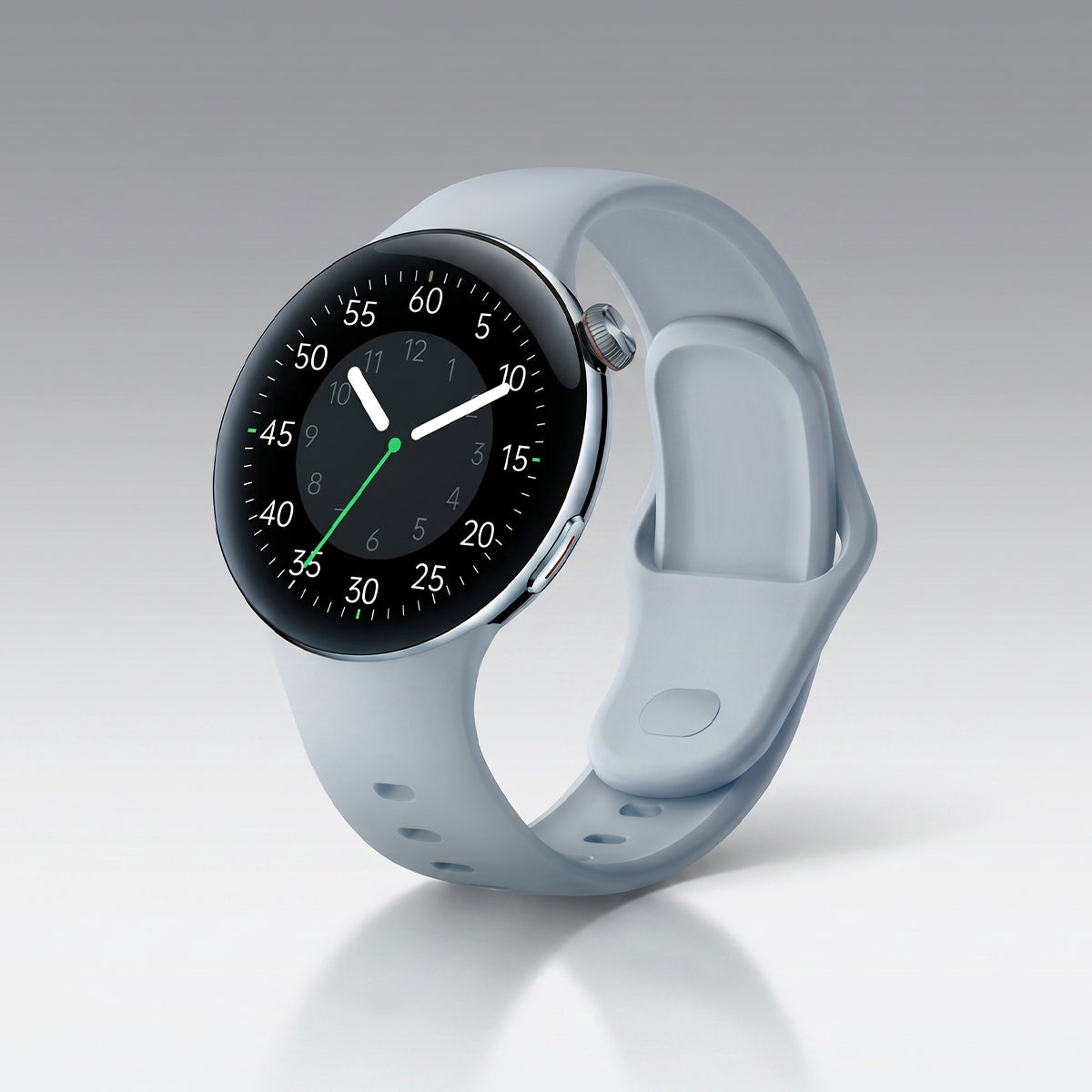








You look at your watch. Stress level: 82 — High. You feel fine. You've been sitting on the couch, watching a show, drinking tea.
Or the opposite. You're in the middle of a tense conversation, shoulders tight, jaw clenched. Your watch says Stress: 24 — Low.
So which is it? Is your watch broken, or are you?
Neither. Your watch is doing exactly what it was designed to do — measuring physiological arousal, not your emotional experience. Those two things are related, but they're not the same. And once you understand what's actually feeding that score, you'll know when to take it seriously and when to roll your eyes.
The Three Signals Behind Your Stress Score
Your watch doesn't measure stress. No sensor can. What it measures is your autonomic nervous system — the part of you that regulates heart rate, sweat, and digestion without conscious thought. It does this using three inputs:
1. HRV — the foundation
Heart rate variability is the tiny variation in time between heartbeats. High HRV generally means your parasympathetic system ("rest and digest") is in charge. Low HRV means your sympathetic system ("fight or flight") has taken over.
This is the backbone of most stress scores. But it's also a general-purpose signal. A hard workout, a fever, two glasses of wine, and a stressful email all lower your HRV. Your watch can't tell them apart.
2. EDA — the sweat signal
Some wearables add electrodermal activity (EDA) sensors, which measure tiny changes in how your skin conducts electricity. Your sweat glands are controlled by the sympathetic nervous system, so when you're aroused — stressed, excited, nervous, or just hot — they get slightly more active before you even notice.
EDA is a strong signal, but it's also a blunt one. Physical stress and psychological stress look identical to an EDA sensor. A stressful meeting and a warm room produce the same sweat response. A run and an argument both raise your skin conductance.
3. Motion — the overlooked context
This is where a lot of models fall short. If a stress algorithm relies only on HRV or EDA, it gets confused constantly — because movement affects both signals dramatically.
Adding accelerometer and gyroscope data significantly improves accuracy. It lets the algorithm distinguish between "heart rate elevated because you're walking upstairs" and "heart rate elevated because you're anxious." It tells the model whether the body is active, and therefore whether the autonomic signal should be interpreted as exercise or arousal.
When you see a stress score that feels surprisingly accurate, it's usually because the motion data was clean — you were sitting still, and the autonomic signal was genuinely rising.
Why "Accurate" and "Inaccurate" Are Both True
Here's the honest scientific picture:
Correlations are moderate. Studies comparing consumer wearable stress scores to validated psychological questionnaires typically find correlations in the r = 0.5 range. That's meaningful — the watch is picking up something real. But it also means roughly half the variation in the score is not explained by perceived stress.
Brands vary widely. A 2026 systematic review of consumer wearables found significant differences in both the sensors used and the algorithms applied. Some devices rely primarily on HRV; others combine HRV, EDA, and motion. Devices with multi-signal fusion consistently outperform single-signal models, but even the best consumer devices are not clinical instruments.
The context problem is unsolvable at the wrist. A watch can't know you just had a difficult phone call. It can't know you're excited about a date, or grieving, or about to give a presentation. It only knows that your heart rate is up and your skin is sweatier than usual. That's not stress — that's arousal, and arousal has many sources.
So when someone asks "is my watch's stress score accurate?" the truthful answer is: it's accurate at detecting physiological arousal. It's only moderately accurate at translating that into "stress" as you experience it.
When to Pay Attention — and When to Ignore It
Here's a simple framework.
Ignore it when:
-
It's a single reading. One spike at 3 PM means nothing. You might have stood up too fast. You might have had coffee. You might have gotten good news.
-
You know why it happened. If you just finished a workout, climbed stairs, or walked through a hot parking lot, your stress score is reading the wrong thing.
-
It contradicts how you feel. Your watch says high stress, but you feel calm and relaxed. Trust yourself. The watch is a sensor, not an oracle.
-
You're wearing it loose. A loose band means motion artifacts, poor PPG contact, and unreliable data. Check the fit before you believe the score.
Pay attention when:
-
The trend is persistently elevated over days. A week of high stress scores — especially if it aligns with how you feel — is a signal worth investigating.
-
It matches your subjective experience. Your watch says high stress, and you do feel wound up. That agreement is meaningful. It confirms the signal.
-
It shows the same pattern at the same time each day. If your stress score spikes every morning at 9 AM, that's a pattern. Maybe it's your commute. Maybe it's the morning meeting. The pattern is more valuable than the number.
-
It disagrees with your training readiness. If your HRV is low, your stress score is high, and your sleep was poor, your body is telling you something. Maybe you should skip the hard workout.
How to Actually Use Stress Data
Your watch's stress score isn't a diagnosis. It's a prompt for reflection. Here's how to make it useful:
1. Use it as a log, not a label.
When your stress score spikes, ask yourself: What was I doing? How did I feel? Over time, you'll start to see what actually drives your physiological arousal — and it might not be what you expect. For some people, caffeine is the culprit. For others, it's a specific meeting or a certain time of day.
2. Cross-reference with your HRV trend.
A single high-stress score means little. But if your stress score has been climbing for a week, and your HRV has been dropping, and your sleep quality has been declining — that's a pattern worth acting on. Take a rest day. Go to bed earlier. Talk to someone.
3. Use it to calibrate recovery, not to judge yourself.
The most practical use of stress tracking is deciding when to push and when to back off. If your stress score is high and your HRV is low, do an easy workout instead of intervals. If both are normal, go ahead and train hard. The data is a tool for adjusting — not a verdict on your character.
4. Don't let it stress you out.
The irony is real. If seeing "high stress" on your wrist makes you feel more stressed, turn the feature off. A tool that increases your anxiety isn't a tool. It's a problem.
The Bottom Line
Your watch isn't measuring stress. It's measuring HRV, EDA, and movement, then guessing what those signals mean about your nervous system. Sometimes the guess is good — especially over days and weeks, and especially when motion data helps separate exercise from arousal. Sometimes it's confused by a hot room or a cup of coffee.
Use the trend, not the number. Cross-check with how you feel. And if the score disagrees with your body, trust your body.
Your watch is a useful mirror. But it's not the person in the mirror. 🪞


Dejar un comentario
Este sitio está protegido por hCaptcha y se aplican la Política de privacidad de hCaptcha y los Términos del servicio.