

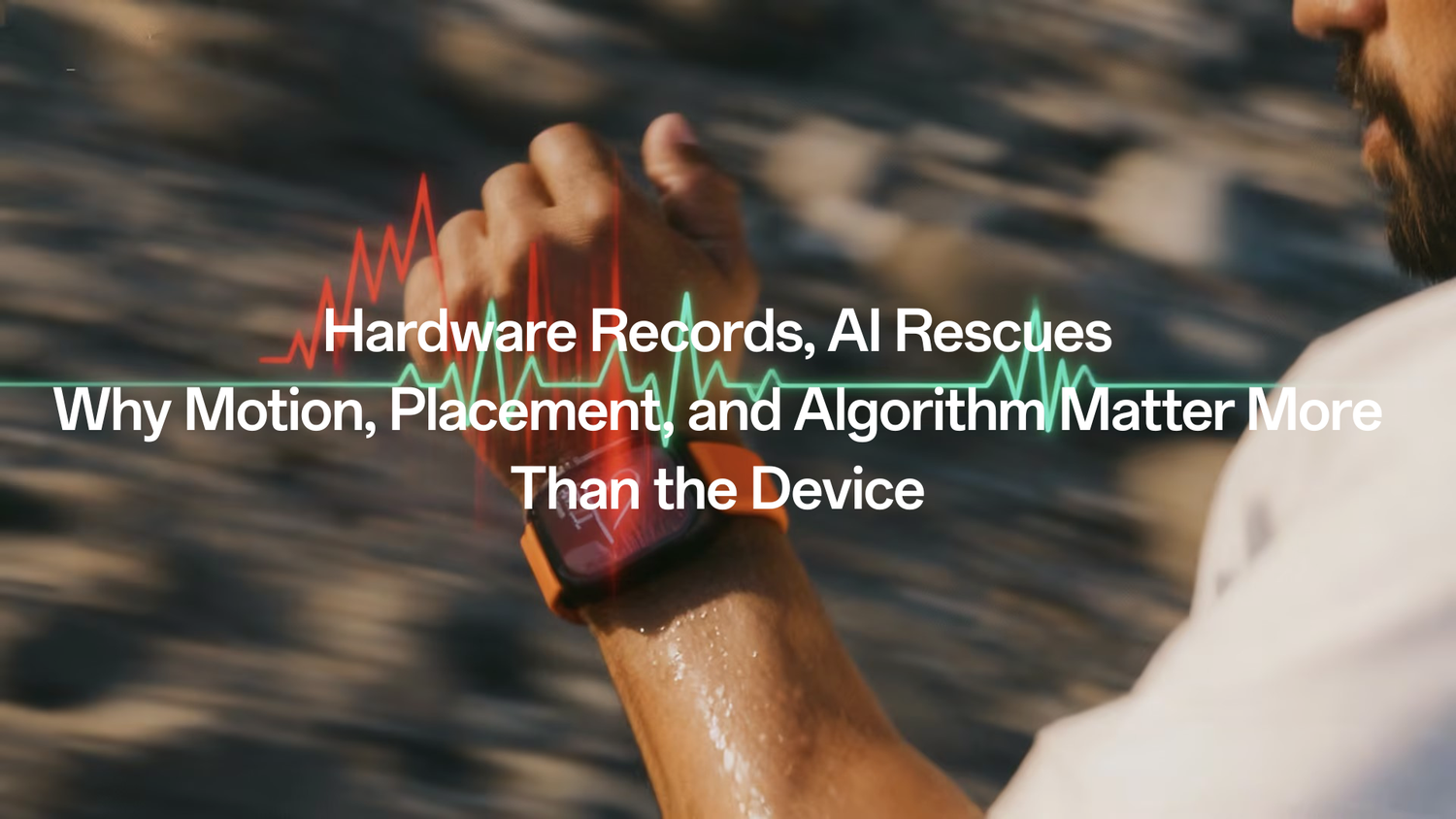
Introduction: The Wearable Paradox—Why Your Device Is 'Collecting Errors'
If you own a smart ring, watch, or chest patch, you’ve likely experienced the moment of data betrayal: an inexplicable spike in your heart rate (HR) or respiratory rate (RR) when you were merely scratching your head or making coffee. You naturally assume the hardware is faulty. The truth, however, is more complex: the hardware is doing its job by recording what it sees, but in the messy reality of daily life, the sensor’s primary job becomes collecting errors.
Most continuous monitoring relies on optical signals (PPG) or micro-vibrations (SCG/BCG). The slightest physical disruption—known as Motion Artifacts (MA)—can overwhelm the tiny, legitimate physiological signals. This problem is not minor; studies report that between 44% and 86% of PPG signals captured by wearables are of insufficient quality for pulse rate monitoring.
The core conflict is this: MA noise often overlaps in frequency with the vital signals you care about, rendering simple noise filters useless. Therefore, the metric of success is no longer hardware fidelity but software resilience.
The hard truth is: Hardware records the errors; AI is responsible for rescuing them. Without the latter, the former is just a toy. To gain trustworthy insights from your device, you must adopt the three Algorithm Golden Rules.
Golden Rule I: Check for "Algorithm Insurance"
You can’t stop moving, so your device must be smarter than your movement.
When evaluating a wearable, shift your focus from the hardware specifications to the invisible logic—the "algorithm insurance" designed to ensure data robustness.
Your Action Checklist: Choose a device that explicitly mentions multi-sensor fusion (PPG + ACC) and machine learning.
Why This Works: The Noise Reporter
The AI’s first line of defense is redundancy. Instead of relying solely on one sensor—like a PPG light sensor—smart devices incorporate an Accelerometer (ACC) or an Inertial Measurement Unit (IMU). These auxiliary sensors act as the "Noise Reporter".
The Mechanism: ACC precisely records every time your hand, arm, or chest moves. For methods like Seismocardiography (SCG), a chest accelerometer is commonly used to record body position, which can then be used to filter out signal interference caused by body movements.
The Value: The algorithm uses the ACC data as a motion reference signal in sophisticated adaptive filters. This is critical because simply filtering often fails to eliminate motion distortion.
The Contrast: A retrospective evaluation of an RR algorithm using a multi-sensor fusion approach (PPG + ACC) was tested against a standard PPG method. The standard PPG method produced a Mean Absolute Error (MAE) of 5.5 ± 3.1 brpm, but when the device was equipped with fusion, the MAE dropped significantly to 2.7 ± 1.6 brpm over a wide range of 4–59 brpm. This contrast shows that multi-sensor AI reduced the error by nearly 50% in clinical testing.
The Deep Learning Safety Net
For high activity or unpredictable movement, the AI needs the ability to learn and reconstruct the signal. Techniques like Machine Learning (ML) and Deep Learning (DL) are increasingly used to expand beyond conventional signal processing. For example, a wearable respiration sensor using an accelerometer and a random forest classifier achieved an accuracy of up to 93.4% while being less sensitive to motion artifacts. This illustrates the transition from classical filtering toward sophisticated data processing based on classification and regression.
Golden Rule II: Master the "Placement Playbook"
Even the smartest algorithm can’t help if it’s fed garbage data. That’s where correct placement becomes critical.
Even with powerful AI correcting errors, minimizing the "noise floor" is essential. This requires the user to understand that sensor accuracy is highly dependent on where and how tightly the device is worn.
Your Action Checklist: For mechanical sensors (like straps or patches), adjust placement based on posture: Upper abdomen when sitting, navel when supine. Ensure stable, non-occlusive contact.
Positioning Is Posture-Dependent
Devices that measure chest or abdominal expansion (like piezoresistive sensors or E-textiles) are sensitive to movement amplitude. Where the movement is greatest depends on your body position.
The Evidence: A prospective observational study used stretch sensors to measure RR at five different locations. The sensors detected the largest amplitudes at the epigastrium (upper abdomen) while sitting and at the umbilicus (navel) while in the supine position. This confirms the optimal placement shifts.
The Challenge of Movement: The difficulty of accurate data acquisition is clearest during exercise. The RR error of stretch sensors was small at rest (e.g., 0.06 breaths/min error at the umbilicus). However, post-exercise, the detected RR was 1.57 to 3.72 breaths/minute greater than the spirometer reference. This increased scatter highlights the critical need to maintain optimal contact and stability, as seen with chest straps which offer great stability during dynamic movements like sports.
Contact Quality is Paramount
Whether using Bioimpedance, PPG, or mechanical sensors, accuracy requires direct, stable skin contact.
-
The Risk: Insufficient contact pressure can lead to a weak signal, while excessive pressure can block circulation and deform the PPG signal.
-
New Solutions: Patches that use self-adhesive dry electrodes are being developed precisely to meet the unmet needs of long-term wear, comfort, and enhanced stability to reduce motion artifacts via a more secure skin attachment.
Golden Rule III: Trust the Algorithm’s Universal Language
Once movement is accounted for, you need assurance that the results aren't biased by your body's unique physiology.
The final test of AI robustness is its equity—its ability to maintain accuracy regardless of user differences, such as skin tone or BMI.
Your Action Checklist: Only trust devices validated in clinical settings across diverse BMI and skin tone cohorts. Demand transparency regarding Signal Quality Assessment.
Overcoming Skin Tone Bias: The Mini-Story of Neutrality
Optical sensors (PPG) are intrinsically sensitive to skin pigmentation because melanin absorbs light. However, sophisticated AI trained on fused sensor data has proven capable of correcting this bias.
The Evidence: Clinical validation of a wearable PPG-based monitor compared RR measurements across different Fitzpatrick skin tones. In patients with darker skin tones (Fitzpatrick 4–6), the correlation between the wearable and the medical-grade reference device remained extremely high (e.g., 98.9%, p < 0.001). This remarkable outcome confirms that the AI can achieve accurate, valid measurements in diverse populations.
Universal Applicability: This robustness extends to body size. The same studies showed that even when participants were stratified into normal weight, overweight, and obesity (BMI ≥ 30) groups, the wearable device maintained high accordance with medical standards, showing correlations of 96.0% to 99.2% in one study set.
The True Meaning of Reliability: Signal Quality Assessment (SQA)
Don't panic if your device reports gaps or warnings. The latest AI no longer views signal quality as a "black and white matter" (good or bad). Instead, it uses Signal Quality Assessment (SQA) to quantify confidence.
SQA in Action: The SQA system acts as an integral part of the processing pipeline, preventing the exclusion of imperfect but useful signal segments. It is important because the algorithm should be able to confidently predict outcomes, even from just a few seconds of clean samples embedded in an otherwise noisy signal.
Your Interpretation: When your device utilizes SQA (which may be displayed as a confidence metric or data gaps), it indicates the AI is working to maximize the use of high-quality sub-segments. This commitment to continuous, high-quality information is vital, particularly in clinical contexts where continuous monitoring is needed for early detection of deterioration.
Conclusion: The Only Path to Trustworthy Data
The shift from hardware fidelity to algorithmic robustness is not a minor trend; it is the fundamental technological requirement for wearable monitoring to move beyond the consumer space into clinical reliability.
By adopting these Algorithm Golden Rules, you ensure your device is equipped to handle the unpredictable challenges of real life:
-
Select Fusion: Only choose devices that use multi-sensor fusion (like PPG + ACC) and AI to actively correct inevitable motion errors.
-
Respect Placement: Minimize noise by adhering to posture-dependent placement rules (e.g., upper abdomen vs. navel for strain sensors).
-
Trust the Correction: Rely on devices with validated algorithms that demonstrate neutrality against physiological differences (skin tone, BMI) and use SQA to deliver continuous, honest data.
The most valuable health devices are not those that are perfectly accurate in a laboratory, but those that are resilient enough to deliver reliable data in your hands, every day.

Leave a comment
Situs ini dilindungi oleh hCaptcha dan berlaku Kebijakan Privasi serta Ketentuan Layanan hCaptcha.