

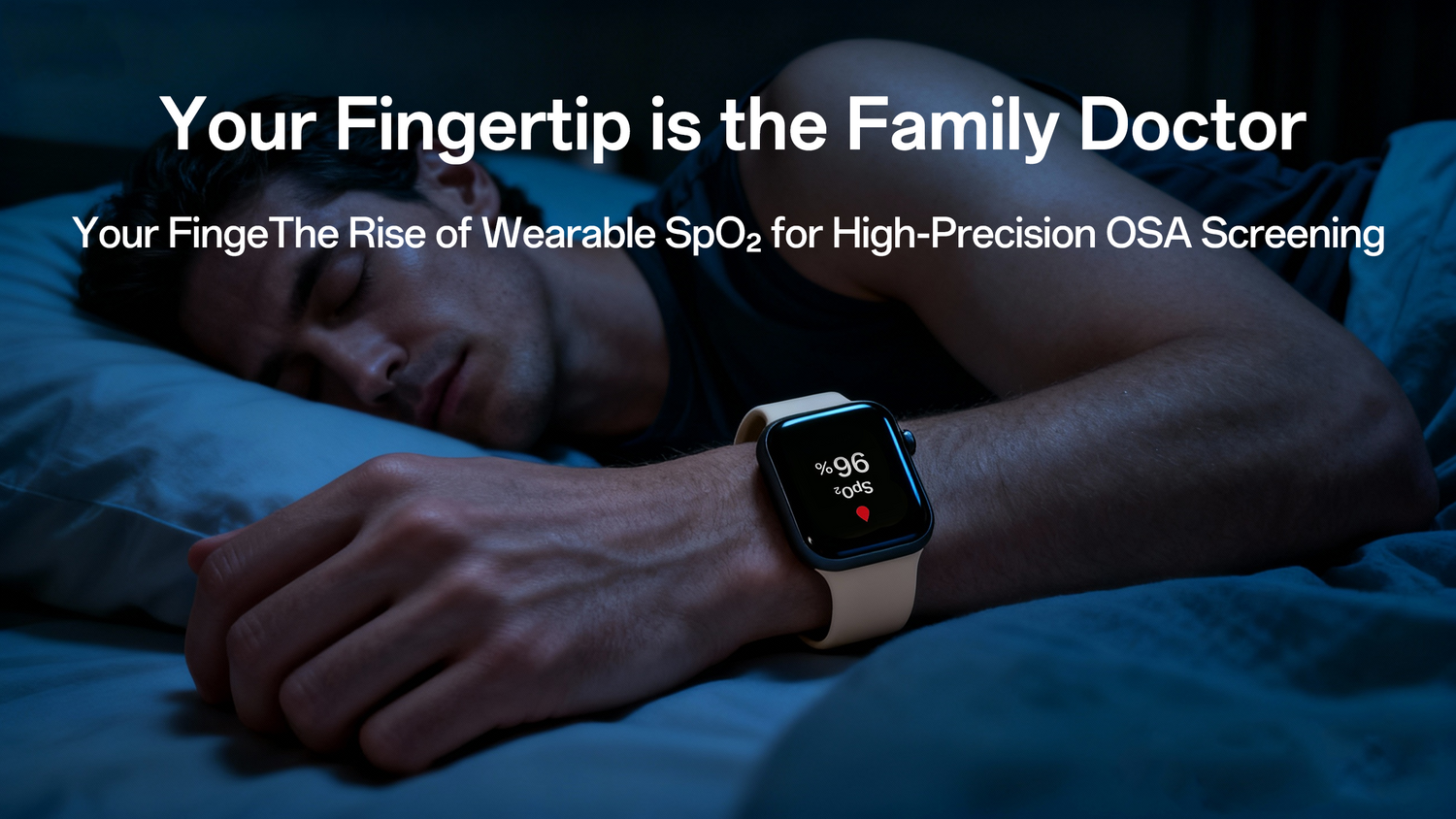
Introduction: The Invisible Crisis and the Diagnostic Bottleneck
Obstructive Sleep Apnea (OSA) represents a silent, colossal health burden, estimated to affect nearly one billion people globally. Despite its clear association with severe comorbidities—including stroke, hypertension, and cognitive decline—OSA remains vastly underdiagnosed. The traditional gold standard, Polysomnography (PSG), is centralized, expensive, and inconvenient, forcing patients to spend a full night wired up in an unfamiliar setting. This procedural friction translates directly into long waiting lists and delayed care.
The solution to this systemic bottleneck is the integration of advanced wearable technology, turning the patient's home into a proactive sleep clinic. Our stance is clear: SpO₂-enabled wearable devices are the core element of this medical revolution, acting as a verified, high-precision warning radar that accelerates patients from screening to life-saving treatment. This transformation rests on a continuous logical progression: first, demonstrating the signal's clinical fidelity; second, augmenting that signal with intelligent algorithms; and finally, establishing an efficient treatment loop.
Chapter I: Scientific Foundation—The Finger Light Delivers Clinical Precision
Before technology can fix sleep apnea, it must first learn to measure it with clinical precision.
The success of home-based OSA screening hinges on identifying a simple, non-invasive biomarker that faithfully reflects the severity metrics (AHI) scored in a complex PSG lab. This quest has centered on the SpO₂ signal, monitored non-invasively, often using finger rings or wrist-worn devices.
The Reliability of the cODI3% Metric
Clinical validation studies demonstrate that the SpO₂-derived 3% Oxygen Desaturation Index (cODI3%)—which measures significant drops in blood oxygen per hour—is highly correlated with PSG findings.
-
Quantitative Agreement: The correlation between the cODI3% measured by wearable oximetry rings (e.g., Circul®) and the ODI3% measured by PSG is notably strong (R² value of 0.9012), cementing its reliability as a surrogate parameter for OSA severity.
-
High-Risk Exclusion: For the critical threshold of moderate-to-severe OSA (AHI ≥ 15 events/hour), wearable devices prove exceptionally reliable. Using a cODI3% cutoff value of ≥ 13.1, one device demonstrated 100% specificity against the PSG benchmark. This means that when the wearable flags a patient above this level, the likelihood of a false positive is negligible, providing high confidence for immediate medical referral.
-
Widespread Screening Efficiency: For general OSA risk (AHI ≥ 5), specialized smartwatches and oximeters are highly sensitive. For example, the OPPO Watch Sleep Analyzer (OWSA) demonstrated a sensitivity of 95.4% and an accuracy of 93.9% for this initial screening threshold.
In simple terms, this transformation rests on one crucial fact—the tiny red light on your wearable can now deliver hospital-grade data, offering immediate, non-invasive risk stratification.
With this fundamental validation established, the next frontier is no longer whether the signal is reliable—but how to make it truly intelligent, overcoming the inherent limitations of small, convenient hardware.
Chapter II: AI Empowerment—Turning Raw Signals into Clinical Insight
The challenge of wearable OSA detection is that small form factors (like rings or watches) sacrifice the high granularity of PSG's many sensors. Artificial Intelligence (AI) is the necessary engine to bridge this gap, allowing consumer-grade data to achieve clinically relevant accuracy.
Deep Learning as the Pattern Recognizer
AI techniques, especially Deep Learning (DL) architectures like Convolutional Neural Networks (CNN), are proving to be superior pattern recognizers for subtle breathing interruptions.
-
Performance Metrics: Studies synthesizing research on wearable AI confirm its effectiveness in identifying OSA patients, achieving a pooled mean accuracy of 86.9% and pooled sensitivity of 93.8%. This superior performance often stems from CNN's ability to capture the localized time-based patterns characteristic of apnea events.
-
Multimodal Data Fusion: The smartest wearables leverage multiple, complementary data streams to improve robustness. Devices like the OWSA combine Photoplethysmography (PPG) for SpO₂ and heart rate, with accelerometer data for movement, and even snoring recordings, feeding these inputs into interpretable AI models. This multi-modal approach yields high correlation with PSG-AHI.
-
Overcoming Low-Resolution Data: A significant technical breakthrough lies in processing data from common consumer devices (like the Apple Watch or Fitbit). Research shows that by using a technique called multi-scale feature engineering, AI can extract powerful insights even from coarsely grained SpO₂ signals over extended timescales (up to 600 seconds). This means that while traditional markers lose relevance at low resolution, specialized non-linear features (like complex entropy) maintain strong correlation with AHI.
Wearable AI Performance for OSA Detection
| AI Goal | Pooled Mean Accuracy | Best Signal Type | Implication | |
|---|---|---|---|---|
| Detecting OSA Patients | 86.9% | Respiration data and SpO₂ combination | High sensitivity (~93.8%) means the model is excellent at flagging people with the disease. | |
| Estimating Severity Score (AHI) | 87.7% (Correlation Coefficient r) | Chest and Abdomen placement (high sensitivity) | Models accurately correlate their output with the clinical severity score. |
In simple terms, AI, especially CNN models, are proving to be better pattern recognizers than humans when it comes to spotting subtle breathing interruptions. They are quietly learning to read your body like a doctor would, leveraging convenience to gather enough data to be statistically intelligent.
But intelligent monitoring alone is insufficient; the final, crucial step is ensuring that the moment the radar flashes red, the healthcare system is ready to act decisively.
Chapter III: The Action Loop—Telemedicine's Role in Treatment Acceleration
The core problem is not just diagnosis, but the long, arduous road to treatment. The final step is integrating the smart diagnosis into a responsive system.
The advent of highly accurate home screening has seamlessly paved the way for Telemedicine (TM), which closes the loop by drastically reducing waiting times and streamlining chronic management. This shift in logistics translates directly into better patient outcomes.
Cutting the Waiting List: The Power of TM
TM allows physicians to remotely diagnose, titrate CPAP pressure, and monitor adherence, bypassing the physical constraints of the sleep lab.
-
Accelerated Therapy Initiation: Randomized controlled trials (RCTs) provide the clearest evidence of TM's speed advantage. A home-based TM strategy for APAP initiation was found to be non-inferior to standard lab-based management but facilitated significantly faster access to therapy. The time to APAP initiation was reduced from an average of 46.1 days to just 7.6 days (p<0.0001). This confirms that Telemedicine is turning what used to be a six-week waiting list into a week-long turnaround.
-
Cost-Effectiveness and Convenience: Remote care is demonstrably more financially sensible. TM is generally considered a cost-effective solution. From the patient perspective, one trial comparing a Virtual Sleep Unit (VSU) to Hospital Routine (HR) found VSU resulted in lower total costs, with patients saving approximately 167 € in non-medical costs (e.g., travel expenses). Patients themselves appreciate the flexibility of consultations and the savings on travel.
Sustaining Success: Remote Adherence Support
TM is also crucial for long-term adherence to CPAP therapy, a chronic challenge in OSA management.
-
Improved Compliance: Systematic reviews indicate that TM-based follow-up, often incorporating mobile health (mHealth) apps and remote coaching, can maintain or even improve CPAP adherence. Systems incorporating cloud-based sleep coaches (CBSC) improved PAP adherence at 3 months.
-
Targeted Intervention: The continuous flow of data allows for proactive interventions. In telemonitored patients, the most effective intervention for improving compliance (usage increased by over 30 minutes/night) was pressure adjustment, a task that can be handled remotely using the data provided by the TM platform.
Chapter IV: Conclusion and the New Frontier of Sleep Health
The integration of SpO₂ wearables, AI, and TM has solidified a new, efficient medical pathway: Problem Identification → Precision Screening → Accelerated Intervention.
This new paradigm offers a massive advantage in patient accessibility, cost reduction, and speed. However, to maintain an authoritative, constructive view, we must recognize that the work is not complete.
Translating Limitations into Opportunities
The primary scientific challenge for the next generation of wearables is accuracy, particularly in compensating for the missing data streams (EEG, airflow) of PSG.
-
Addressing AHI Underestimation: SpO₂-based devices inherently tend to underestimate AHI because they often miss hypopneas (reduced breathing events) that do not cause a ≥ 3% oxygen drop, or miss breathing interruptions that lead only to a neurological arousal. This is a physiological limitation. The future of AI screening must therefore focus on multi-modal solutions that incorporate other signals (like movement or sound) to capture these missed events and advance the field toward more comprehensive metrics like Hypoxic Burden.
-
Optimizing AI Deployment: While AI performance is strong, the best AI models often reside on non-commercial devices. Manufacturers must prioritize Deep Learning, specifically CNN architectures, in commercial products to enhance performance. Furthermore, sensor placement significantly impacts performance, with noncommercial devices placed on the chest and abdomen showing superior sensitivity compared to those on the wrist or finger for general sleep apnea detection. This suggests the convenience of the finger or wrist must be continually balanced against diagnostic fidelity.
-
Standardizing Clinical Adoption: The rapid technological advance means that published validation studies quickly become obsolete. Future research needs standardized protocols for data collection and validation across diverse populations—including elderly and pediatric subjects—to ensure generalizability and establish universal guidelines for when AI-based wearables can truly complement or replace PSG.
By facing these challenges, the medical community will ensure that the power held at the patient's fingertip—the ability to monitor their health continuously and affordably—is fully harnessed to deliver the highest standard of personalized sleep care.


Leave a comment
Situs ini dilindungi oleh hCaptcha dan berlaku Kebijakan Privasi serta Ketentuan Layanan hCaptcha.