

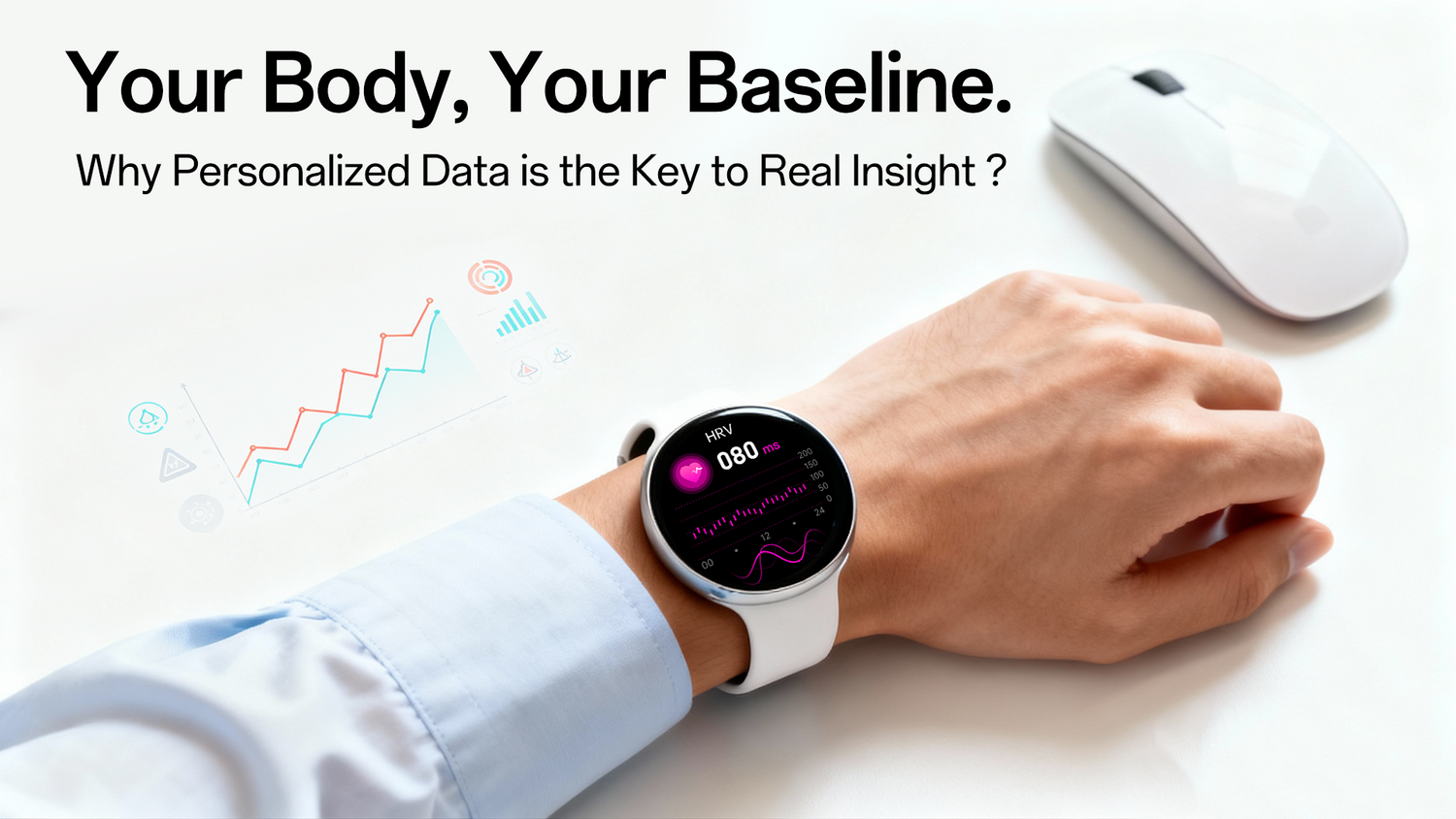
Introduction: Why Doesn't My Watch Understand My Stress?
We’ve all experienced the same frustration: you check your smartwatch during a frantic work deadline, expecting a high-stress alert, only to be told you are "calm." Conversely, perhaps the device flags a high-stress event when you were merely climbing stairs or watching an action movie. This disconnect between what our wearables measure and what we subjectively feel represents a fundamental paradox of the digital pulse.
While Heart Rate Variability (HRV) has long been scientifically established as a vital marker of stress, health, and disease, reflecting the resilience of our nervous system, the transition of this measurement from controlled labs to daily life is proving complex. New, rigorous field studies are confirming that traditional, generalized algorithms—the kind that power most mass-market apps—are simply insufficient for reliably detecting subjective stress.
This challenge is not a failure of the technology, but a clear signal for the industry's necessary evolution. The scientific consensus is now driving a wearable revolution: moving away from the "one-fits-all" score toward a future where our devices calculate a bespoke "digital baseline" for each individual.
I: The End of "One-Size-Fits-All" — Why Your Data Needs a Custom Lens
The core scientific hurdle is that your body's response to stress is as unique as your fingerprint. When generalized algorithms ignore this individuality, their performance suffers dramatically in real-world environments.
1.1 The Low Correlation Threshold: Why General Models Fall Short
Recent field research, including an 8-week observational study on office employees ($N=36$), confirms that models attempting to predict stress levels for all participants simultaneously perform poorly.
- Quantitative Proof: Under rigorous testing designed to simulate performance on an unseen user (Leave-One-Subject-Out Cross-Validation, LOSO CV), the best-performing general regression model (XGBoost) achieved only a negligible correlation with self-reported stress, with a Spearman's $\rho$ of $0.078$.
- The Invalidation: Researchers note that this result falls in the "negligible to low range" in terms of effect size. Similar findings across various field studies, including one where HRV only explained 2.2% of the variance in self-reported stress, underscore the weak association between a general physiological signature and subjective mental states in the field.
- Scientific Consensus: Because of the "considerable variability in terms of measurements, methods, and outcomes exhibited by stress detection studies," many researchers now argue that a "general, one-fits-all model for stress detection might never reach satisfactory results under real-world conditions". This empirical realization is the key scientific driver accelerating the move toward personalized methods.
1.2 Defining the Right HRV Metrics for Stress
The physiological ambiguity of stress further complicates generalized modeling. Not all HRV measures are created equal when interpreting psychological strain.
- Reliable Time-Domain Metrics: In controlled simulations, time-domain HRV parameters such as RMSSD (root mean square of successive NN interval differences), SDNN, and PNN50 consistently demonstrated robust sensitivity to acute psychological stress. For instance, RMSSD showed a large standardized response mean (SRM = 1.48) and a strong negative correlation ($r = -0.63, p < 0.01$) with salivary cortisol, making it a reliable indicator of parasympathetic withdrawal during acute stress.
- LF/HF Ratio Inconsistency: Conversely, the LF/HF ratio—a metric often conceptualized as the balance between sympathetic and parasympathetic activity—showed an inconsistent performance. In a study comparing mobile applications to reference software (Kubios™), the LF/HF ratio correlation was low and non-significant ($r=0.10, p=0.58$). The lack of consistent support for this metric suggests its reliability diminishes significantly outside of specific, controlled contexts.
Key Takeaway: The "one-size-fits-all" approach fails because your physiological response is unique, and general models cannot differentiate your true psychological stress from simple background noise. Reliable HRV monitoring must focus on proven time-domain metrics (like RMSSD) and reject the idea that a single algorithm can serve billions.
II: Building Your Digital Baseline — The Blueprint for Reliable Monitoring
The next stage of the wearable revolution pivots on a single solution: treating every user as an individual study subject. This involves personalized modeling powered by multimodal data.
2.1 The Personalized Performance Leap
The most promising evidence for the future of stress detection comes from the performance gap between general and personalized models.
- The Power of Individuality: Personalized modeling, where a unique algorithm is trained on a user's own historical data, offers a "more reliable way forward" compared to the one-fits-all approach. By collecting the best machine learning models for each participant, the average performance improved substantially, reaching a mean Spearman's $\rho$ of $0.296$.
- Necessity, Not Luxury: Researchers stress that this individual-centric approach is necessary because a personalized model is capable of accounting for the unique characteristics and patterns of individual stress experiences. This contrasts sharply with the low performance achieved when training data from other participants are used (LOSO CV).
2.2 Multimodal Fusion: Using Context as the Key
To increase the specificity of stress detection in dynamic environments, scientists are moving beyond isolating HRV, arguing for a multimodal approach. Contextual data acts as the necessary interpretation layer for physiological changes.
- Behavioral Data Integration: For office environments, mouse and keyboard usage data—including keystroke dynamics and movement characteristics—are viewed as highly suitable, unobtrusive, and cost-effective sources for stress detection. This integration is supported by the Neuromotor Noise Theory, which states that stress increases neuromotor "noise," leading to measurable imprecise motor control.
- The Performance Benefit: Combining different data sources has demonstrated the potential to improve the overall performance of stress detection models. In some instances, specialized models based on mouse and keyboard features have been found to outperform models based solely on cardiac data. This underscores the critical need for systems that synthesize behavioral clues alongside heart data.
Key Takeaway: Personalized modeling treats you as an individual, not a statistic. Your stress data is only actionable when it is integrated with the context of your life—like how you use your computer—to create a truly tailored digital fingerprint that can actually guide your health management.
III: The Industry Roadmap — Turning Technical Hurdles into Breakthroughs
Achieving the high performance of personalized stress intelligence requires overcoming significant engineering and standardization challenges across the industry. These are the current focal points for scientific advancement.
3.1 Addressing Data Quality and Sensor Integrity
The quest for high-fidelity data confronts the limitations of current sensor technology, particularly concerning data loss and noise.
- The Challenge of PPG Noise: Wrist-worn photoplethysmography (PPG) sensors are susceptible to motion artifacts. Research observed that activities like keyboard typing can lead to a significant amount of artifacts in PPG-based measurements. In a long-term field study, participants had an average of 35.36% missing HRV feature data across observations, underscoring the severity of data quality issues in real-world monitoring.
- The Gold Standard Reference: This challenge is accelerating the push for better technology. Currently, the most reliable data source remains the chest strap device (e.g., Polar H10), which accurately captures R-R intervals with a strong correlation ($r=0.997$) to the gold-standard ECG Holter. The industry's next step is translating this level of data quality into the convenience of the wrist or other unobtrusive form factors.
3.2 Establishing Standardized Algorithms and Validation Protocols
A major methodological challenge lies in the lack of consistent standards for measuring and labeling stress across different products.
- Algorithm Inconsistency: Current consumer-grade HRV mobile applications use algorithms that are often proprietary and inconsistent in calculating HRV parameters. This heterogeneity means that scores generated by different apps are not comparable, leading to the potential for incorrect conclusions and unfounded extrapolations based on faulty data.
- Refining Labeling Consensus: There is a critical need to standardize validation protocols. Researchers caution against the practice of oversimplifying granular stress scores into two discrete classes (e.g., "stressed" vs. "not stressed"), arguing that this sacrifices robustness and generalizability and can diminish construct validity. The scientific community advocates for the continued assessment of validity evidence supporting the intended use of any new technology.
- Longitudinal Commitment: Future research must emphasize the acquisition of large, ecologically valid datasets over longer periods of time per participant. This longer duration is necessary to capture the full range of individual psychological and physiological patterns, including chronic stress and seasonalities, which can heavily influence acute stress responses.
Key Takeaway: The industry consensus is that generalized algorithms perform poorly, but this realization is not a failure—it is the critical scientific evidence driving the development of personalized digital baselines. The challenge now is to refine sensor stability and establish transparent, validated algorithms that can accurately serve the unique health signature of every user, ultimately fulfilling the promise of objective and actionable stress management.


Lämna en kommentar
Denna webbplats är skyddad av hCaptcha och hCaptchas integritetspolicy . Användarvillkor gäller.