








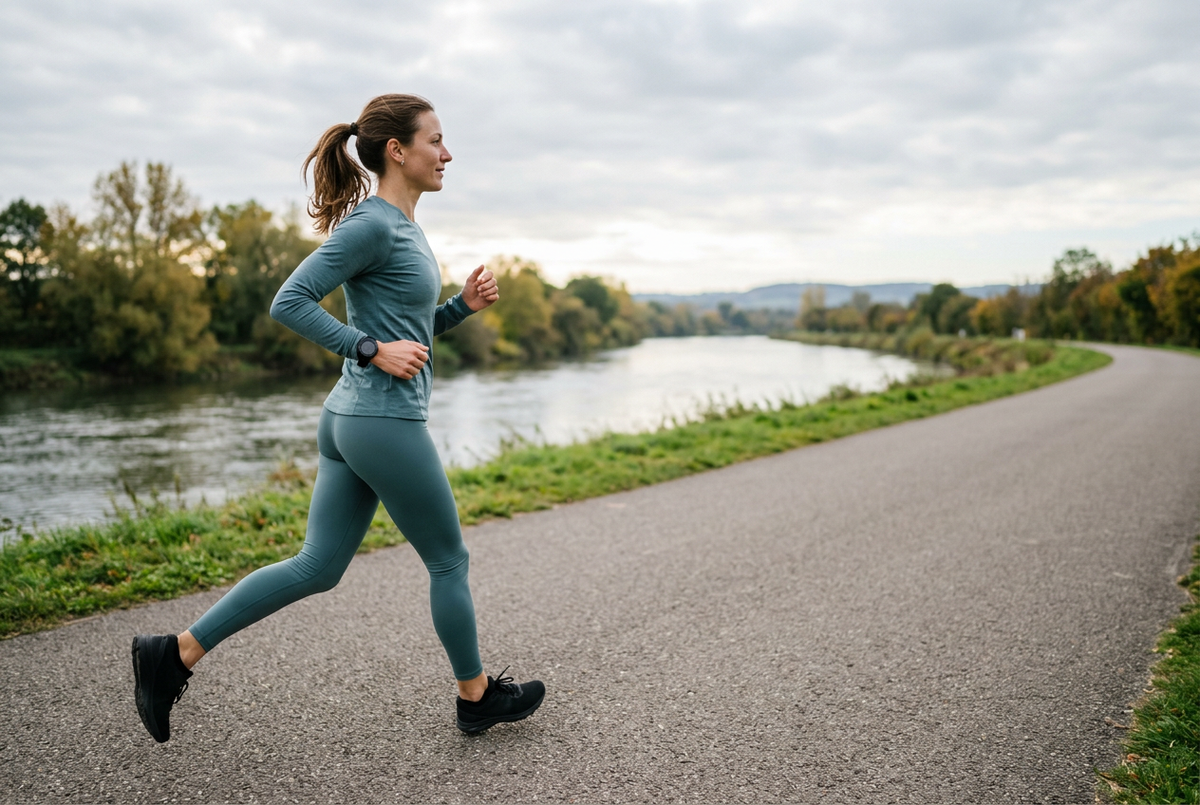
Short answer: It doesn't measure VO₂max. It estimates it. A lab measures the oxygen you actually breathe in and out during maximum effort — a mask, a treadmill, and a lot of discomfort. Your watch watches how your heart rate responds to a given pace, then compares that relationship to population data and your personal stats. The result is usually within 5–15% of a lab value. Good enough to track trends. Not good enough to call yourself elite based on a wrist reading. Here's what's actually happening.
Lab VO₂max vs. Watch VO₂max: Two Different Things
In a lab, VO₂max is measured directly. You wear a mask connected to a metabolic cart that analyzes the oxygen and carbon dioxide in every breath. You run or cycle until you literally can't continue. The machine records the peak rate at which your body uses oxygen — in milliliters per kilogram of body weight per minute.
That's the gold standard. It's also expensive, uncomfortable, and requires a lab.
Your watch has no mask. It can't see your breath. It has heart rate, pace, and your personal profile — and that's it.
So it does something clever: it estimates your VO₂max from submaximal data. You don't need to run to exhaustion. You just need to run at a few different paces and let the algorithm compare your heart rate response to what's typical for people with known VO₂max values.
The Inputs Behind the Estimate
Your watch uses three things:
1. Heart rate response to pace. This is the core signal. If your heart rate stays lower at a given pace, your cardiovascular system is more efficient — which correlates with higher VO₂max. The algorithm looks at the relationship between how fast you're moving and how hard your heart is working.
2. Pace or speed. From GPS or the accelerometer. Accurate pace matters here — if your GPS is drifting, the estimate drifts with it.
3. Your personal stats. Age, weight, sex, and sometimes resting heart rate or HRV. These calibrate the population model to you. Wrong stats mean a wrong estimate.
The algorithm then compares your heart-rate-to-pace relationship to models built from thousands of people who did undergo lab testing. Your pattern gets mapped onto that dataset. The output is a number that looks like a lab result but isn't one.
Why You Don't Need to Run to Exhaustion
This is the part most people find surprising: your watch doesn't need you to hit maximum effort. It can estimate VO₂max from submaximal efforts — runs where you're working, but not sprinting.
The logic is simple. At a given pace, your heart rate tells a story about your fitness. A fit person's heart beats slower at 6:00/km than an unfit person's. The algorithm knows roughly what heart rate ranges correspond to what VO₂max ranges across a population. It places you on that spectrum based on your data.
What this means for you: You don't need to do a lab-style test. But you do need good data. A few steady outdoor runs with accurate GPS and a snug heart rate sensor will produce a much better estimate than a treadmill run with no GPS and a loose band.
What Messes Up the Estimate
The estimate is only as good as its inputs. Here's what throws it off:
GPS error. If your pace is wrong, the estimate is wrong. Treadmill runs are particularly problematic — no GPS, and the accelerometer-based distance is an approximation. Outdoor runs with a clear sky are best.
Heart rate inaccuracy. A loose band, a cold wrist, or motion artifacts can corrupt the heart rate signal. If the watch can't trust your heart rate, it can't trust the estimate.
Wrong personal stats. If your weight or age is off, the population model is calibrated wrong. Even a few kilograms can shift the number.
Running surface and conditions. Hills, heat, and wind change your heart rate response. The algorithm tries to account for this, but it's not perfect.
Training style. If you only do intervals, or only do easy runs, the model has less data to work with. A mix of paces gives a better picture.
Why Your Number Fluctuates
Your VO₂max estimate can jump around from week to week, and that's normal — it's an estimate, not a measurement. A few reasons it moves:
-
A bad GPS day can lower your estimate temporarily
-
A hot run raises heart rate, which can make your fitness look worse
-
A great run on a cool day can make it look better
-
Algorithm updates can shift the number without any change in your fitness
Don't obsess over week-to-week changes. Look at the trend over months. If your VO₂max is climbing over 8–12 weeks of consistent training, that's real. If it drops 2 points after one hot run, that's noise.
How to Get the Most Useful Number
If you want your VO₂max estimate to be as meaningful as possible:
1. Run outdoors with GPS. Treadmill estimates are rougher. Outdoor runs with a clear sky give the algorithm the best data.
2. Wear the watch snug. A loose band means motion artifacts and unreliable heart rate.
3. Update your weight and age. These are the calibration inputs. Keep them current.
4. Do a mix of paces. Easy runs, steady runs, and some harder efforts give the algorithm more to work with.
5. Use a chest strap for the best heart rate data. If you're serious about tracking VO₂max, a chest strap eliminates the optical sensor's weaknesses.
6. Look at the trend, not the number. A single reading means little. Three months of climbing numbers means your training is working.
The Bottom Line
Your watch isn't measuring your VO₂max. It's estimating it from your heart rate, your pace, and your stats — and it's usually within 5–15% of a lab value. That's good enough to track your fitness over time. It's not good enough to compare yourself to a lab-tested athlete.
Use it as a trend line. Fix the inputs. And don't let a bad run tank your confidence. Your cardiovascular fitness is changing slowly. Your watch's estimate should be read the same way. 🏃


Hinterlasse einen Kommentar
Diese Website ist durch hCaptcha geschützt und es gelten die allgemeinen Geschäftsbedingungen und Datenschutzbestimmungen von hCaptcha.