

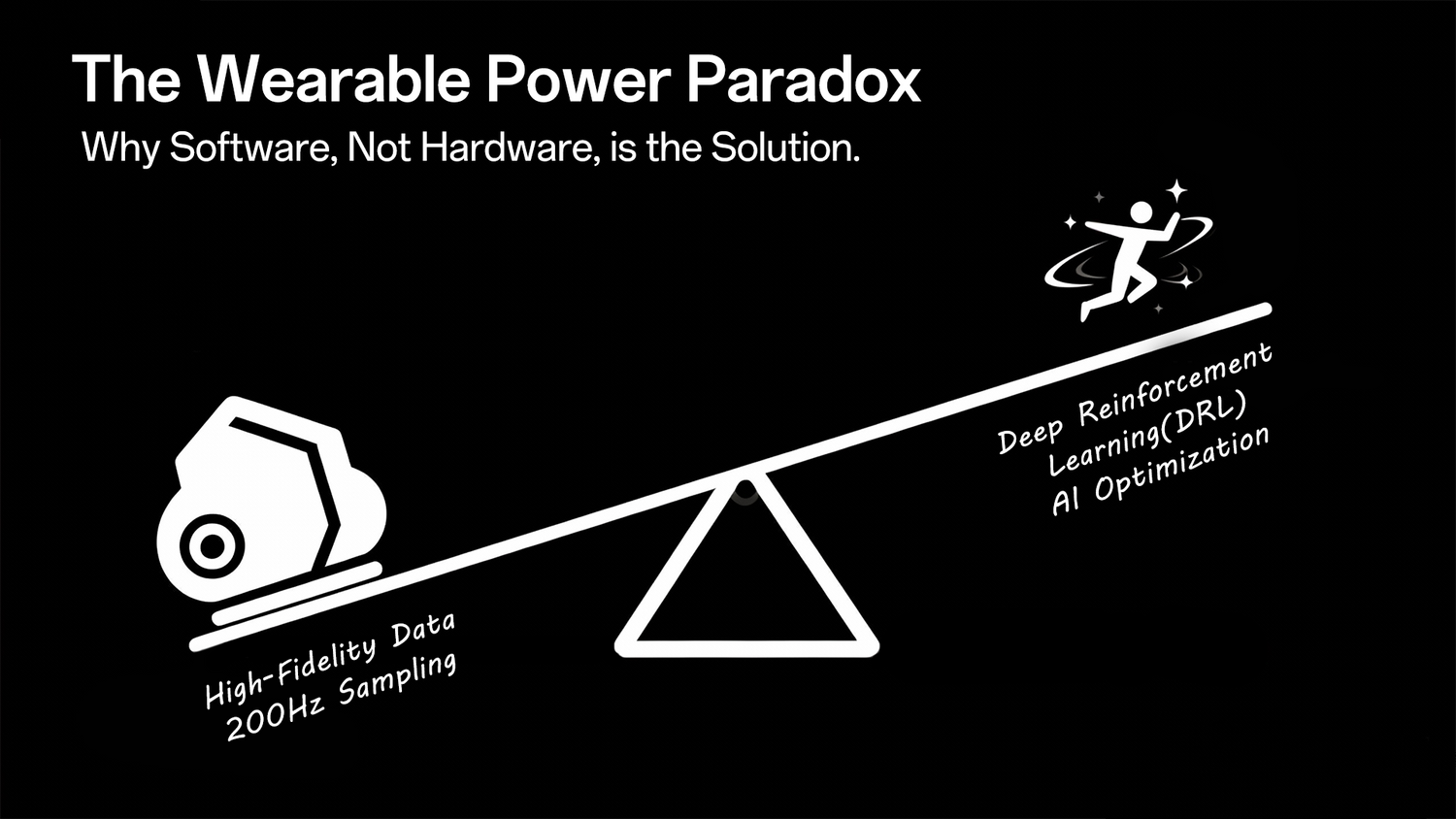
I. The Cost of Precision: Why Hardware Alone Fails
II. Onboard Intelligence: Rescheduling the Computational Load
The true breakthrough is achieved by treating data processing as an adjustable workload rather than a fixed cost; the significance of this strategy is not merely energy saving, but providing an algorithmic ethics sample for medical sustainability.
To break the energy bottleneck, the computational workload must be radically restructured through intelligent software techniques. Wireless communication (e.g., BLE) is one of the most power-hungry operations, consuming substantial energy during frequent data transmission. By prioritizing onboard processing and Edge AI, the device reduces its dependence on this power-aggressive function.
This approach delivers massive, quantifiable savings:
- Data Compression & Local Processing: A proof-of-concept demonstrated that transmitting raw PPG data (200 Hz) via BLE required 5.631 seconds of transmission time per hour, whereas transmitting only the processed 2-byte Heart Rate value required just 0.96 ms. This function of onboard processing saves approximately 2 J of energy per day on BLE transmission alone. Similarly, Compressive Sensing (CS)—a signal compression technique—is widely employed (used in 42% of reviewed ECG works) to minimize power by reducing the data samples required for signal reconstruction.
- Knowledge-Based Adaptive Sampling: This sophisticated strategy dynamically adjusts the sensor’s sampling frequency based on contextual and hardware parameters, such as the available solar energy and the supercapacitor voltage. In low-energy scenarios (e.g., 500 lux indoor lighting), dynamically reducing the sampling frequency from 200 Hz to 50 Hz can save an additional 17 minutes of charging time per hour for the supercapacitor.
- Self-Sovereignty Demonstrated: The efficacy of this combined hardware-software approach is proven by experimental evidence: a self-sustainable, battery-free wristband (50 Hz rate) required only 1.45 hours of indoor light exposure (1000 lux) per day to operate autonomously.
III. The Collaborative Organism: AI-Driven Coordination
Just like the synergistic compensation mechanisms of human organs, energy collaboration among smart terminals and the adoption of Deep Reinforcement Learning (DRL) must be implemented to manage device components holistically.
While onboard processing handles the low-level efficiency, only advanced Deep Reinforcement Learning (DRL) can provide the system-level, real-time adaptability required to balance complex performance and energy trade-offs. Traditional methods, which rely on static rules or historical data, fail to adapt to the real-time fluctuations of user behavior.
The SmartAPM (Smart Adaptive Power Management) framework resolves this by leveraging a multi-agent DRL architecture. This framework grants fine-grained control over individual device components (e.g., CPU, sensors, network interfaces) by training autonomous agents.
3.1 DRL: Reconciling Efficiency with Experience
SmartAPM’s key innovation is integrating user experience into its energy optimization goal through a tunable reward function ($R$): $$R = [W_1 \times \text{PowerSavings} + W_2 \times \text{UserSatisfaction} + W_3 \times \text{ActionPenalty}]$$
- $W_1$ prioritizes energy efficiency, essential for extending battery longevity.
- $W_2$ prioritizes user satisfaction, ensuring compromises do not impair the user experience.
- $W_3$ penalizes excessive modifications, ensuring system stability.
By dynamically modulating these weights based on real-time context (e.g., prioritizing $W_1$ in low battery mode and $W_2$ during demanding tasks), SmartAPM achieves continuous, personalized optimization. This framework demonstrated a simulated 36% extension of battery life compared to traditional methods, while simultaneously increasing user satisfaction by 25%. Furthermore, the integration of transfer learning enables the system to rapidly personalize its strategies to new users within 24 hours.
3.2 Collaborative Inference: Offloading Complexity
For computationally prohibitive tasks—such as running complex Deep Learning (DL) models necessary for highly accurate prediction or motion artifact mitigation—even the most optimized wearable hardware must seek assistance. Collaborative Inference Systems (CHRIS) leverage the computing power of a paired mobile device to dynamically offload high-workload tasks via the BLE link.
The CHRIS decision engine first assesses the "difficulty" of the input data based on the estimated amount of Motion Artifacts (MAs). If the task is simple (low MA), a low-power algorithm runs locally; if the task is complex (high MA), it is offloaded to the smartphone, where the more accurate DL model runs. This energy synergy is critical: CHRIS achieved the same Mean Absolute Error (MAE) of 5.54 BPM (comparable to state-of-the-art DL models at 5.60 BPM MAE) while reducing the smartwatch's energy consumption by 2.03x compared to running the model locally.
IV. The Next Horizon: Sustainability, Privacy, and Clinical Integration
The ascendancy of software intelligence confirms that long-term autonomy is an engineering certainty, but the system's clinical future now hinges on resolving structural hurdles related to data privacy and interdisciplinary governance.
The convergence of adaptive sampling, onboard processing, and DRL-driven holistic control positions wearable technology at the threshold of perpetual operation. However, the adoption of these powerful, continuously-operating devices into mainstream medicine is complicated by persistent non-technical challenges.
- The Privacy and Security Debt: The continuous collection of sensitive health information (e.g., heart rate, physiological patterns) creates substantial data privacy risks, including surveillance, profiling, and misuse. The decentralized nature of the ecosystem—involving manufacturers, developers, and cloud vendors—complicates accountability and necessitates robust, multidisciplinary strategies like privacy-by-design and adherence to regulations (HIPAA, GDPR).
- The Evolving Metric of Value: User expectations have decisively shifted from simple metrics to high-fidelity, actionable data. Surveys indicate that the perceived usefulness of basic step counting has decreased, while Heart Rate monitoring has risen to become the top useful feature (rising from 63% in 2016 to 70.5% in 2023). This growing user demand for continuous, high-resolution cardiac metrics validates the ongoing necessity for highly efficient, intelligent power management techniques that underpin system reliability and long-term user compliance.
Ultimately, the future vision for medical wearables is the creation of self-sustaining, minimally invasive systems. This requires interdisciplinary collaboration across electrical engineering, software development, and biomedical sciences to integrate intelligent power scheduling with existing energy harvesting methods. Only through this holistic and adaptive intelligence can the industry overcome the hardware paradox and guarantee the reliable, continuous health monitoring required for proactive, patient-centric care.


Dejar un comentario
Este sitio está protegido por hCaptcha y se aplican la Política de privacidad de hCaptcha y los Términos del servicio.