

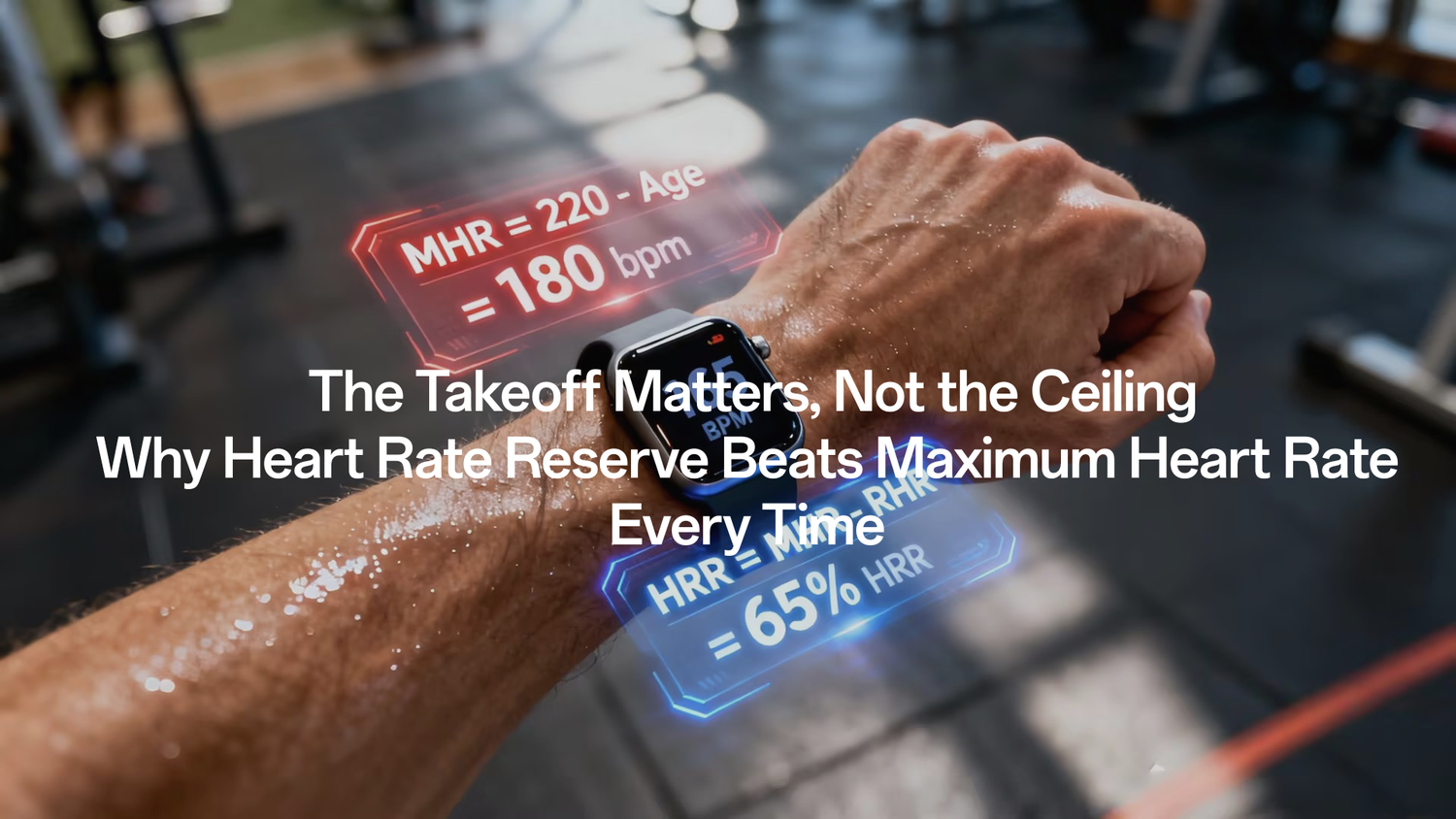
Introduction: The Ceiling Never Mattered—Your Takeoff Did.
For decades, the fitness industry has operated under a fixed delusion: that the intensity of your effort should be measured by how close you push yourself to a predetermined ceiling height—your Maximum Heart Rate (MHR). This model provides a false sense of precision, often calculated with the simple, crude "220 minus age" formula.
The true measure of cardiovascular work is not the fixed ceiling, but the takeoff height: the vertical distance your heart has successfully climbed from its physiological floor. This metric is the Heart Rate Reserve (HRR), and its superiority is the foundation of modern, data-driven performance.
Chapter I: The MHR Deception—Why the "Ceiling" Is a Lie
If training is a jump, MHR tells you the maximum height of the roof, not the effort required to lift your feet off the ground. This single blind spot explains decades of ineffective, one-size-fits-all training plans.
1.1. The Fixed Ceiling: An Input of One
The Maximum Heart Rate (MHR) is inherently flawed because it is almost exclusively dependent on a single input: your age. This makes the resulting calculation inherently non-personalized.
But the real problem isn’t just the ceiling—it’s the floor you’re standing on.
While MHR provides the fixed ceiling, your Resting Heart Rate (RHR) provides the floor, which primarily depends on your fitness level. By relying only on MHR, the system ignores RHR, creating a massive blind spot. This neglect means that MHR fails to achieve the most critical goal of exercise prescription: ensuring comparable exercise-induced stress in individuals of varying fitness levels.
1.2. The Heart Will Lie, But Your Reserve Cannot
The MHR model is built on the dangerous assumption that heart rate always reflects metabolic stress. Research proves this assumption false.
Your heart can lie about your effort.
In prolonged endurance events like the marathon, tracking runners with gas exchange systems showed that %HRmax remained stable (around 88–91%), while their true metabolic effort, the %VO₂max, significantly decreased during the race (p < 0.0001). This metabolic decoupling means that the ratio between the heart rate and the actual energy consumption increases (from 1.01 to 1.19, p < 0.001). Your heart rate is cruising, but your body’s actual metabolic zone has sunk. Therefore, pacing based purely on MHR zones during long efforts is not recommended.
Chapter II: The Physiological Truth—Measuring Your True "Takeoff Height"
To find accurate intensity, you must discard the ceiling and focus on the floor. HRR is the only metric that bridges age constraints and functional fitness.
2.1. The Body Measures Work Relative to Homeostasis
The body doesn’t measure work relative to your maximum. It measures how far you’ve moved away from homeostasis—your resting state. This is the precise physiological meaning of the reserve concept.
The formula for the scientific standard, Heart Rate Reserve (HRR), is simple: HRR = MHR − RHR.
The ACSM (American College of Sports Medicine), the authority on exercise prescription, recommends the use of HRR over MHR. HRR is a superior indicator of relative exercise intensity because it integrates estimated fitness level and the patient's age. This reserve status is so powerful that it better represents the amount of work the heart has to do to raise heart rate from various RHR levels.
2.2. The Mismatch: Why Identical Heartbeats Are Different Efforts
HRR is the scientific equivalent of %VO₂ Reserve (%VO₂R). This relationship ensures that the prescribed percentage of intensity is aligned with your actual aerobic capacity above rest.
Consider two individuals aiming for 150 bpm:
| Individual | RHR (Floor) | MHR (Ceiling) | HRR (Capacity) | 150 bpm (%HRR) |
|---|---|---|---|---|
| A (Trained) | 50 bpm | 200 bpm | 150 bpm | (150-50)/150 = 67% HRR |
| B (Untrained) | 80 bpm | 200 bpm | 120 bpm | (150-80)/120 = 58% HRR |
These two bodies are not doing the same work, even though the number is identical. For Person A, 150 bpm may be moderate-vigorous training (67% HRR). For Person B, it is closer to the edge of the moderate zone (58% HRR). Only by using HRR can you ensure both individuals achieve comparable exercise-induced stress.
Chapter III: The HRR Prescription—Guaranteed Precision in Your Zones
When you use HRR, you stop guessing and start ensuring that every minute spent in a zone achieves the targeted metabolic effect. This is the difference between hoping for results and guaranteeing progress.
3.1. Standardized Effort and Scientific Zones
HRR provides a clear, standardized physiological bracket for intensity:
-
Moderate Intensity (The sweet spot): Defined by ACSM guidelines as 40%–59% HRR.
-
Vigorous Intensity: Defined as 60%–89% HRR.
Failure to use HRR means that you risk completely training in the wrong zone. The traditional conversion of MHR-based to HRR-based zones is generally not feasible, meaning you must choose the correct metric from the start.
3.2. Industry Shift: When Wearables Acknowledge the Reserve
The tech industry's most sophisticated training systems have already abandoned fixed MHR and embraced HRR.
-
Google's Cardio Load (CL), introduced in 2024, is explicitly based on the concept of Heart Rate Reserve. This system exponentially weights intensity as %HRR increases to ensure higher sustained efforts impose proportionately higher strain.
-
This approach, based on the TRaining IMPulse (TRIMP) model, uses %HRR measured continuously throughout the day, recognizing that activity load can be "topped up" with incidental daily activities. This commitment to the reserve concept proves its practical utility for performance measurement.
Chapter IV: HRR and Survival—The Health Underlying Indicator
This difference between the floor and the ceiling—your capacity—is so fundamental that it predicts more than just your next race time. HRR’s value extends to life and death, serving as a powerful clinical predictor.
4.1. The Ultimate Capacity Crisis Indicator
HRR is the only metric that exposes the truth about your health reserve. HRR has been repeatedly demonstrated to be a better indicator of cardiovascular (CV) health and shows a better correspondence with overall CV mortality than MHR.
-
Quantified Risk: Clinical studies found that for each 1% decrease in HRR, the risk for cardiovascular events increased by 2%.
-
Clinical Supremacy: In demanding clinical stress tests (DSE), HRR was shown to be the only predictor of CV events in patients otherwise receiving negative results (p < 0.0001). The failure to reach 70% HRR was superior to 85% MHR as a marker for predicting CV events and mortality.
4.2. The Floor Never Lies: Exposing Metabolic Dysfunction
Your MHR ceiling may look fine, but your takeoff height can tell doctors your health status. HRR is a suitable marker to use for people with Metabolic Syndrome (MetS) to help them better adjust exercise to their metabolic capacity.
-
High Risk: Patients in the lowest quintile of HRR (≤ 105.4 bpm) were about six times more likely to have MetS compared to those in the highest group.
-
Physiological Exposure: HRR also exposes signs of autonomic dysfunction, which is critical for patients using medications that affect the autonomic system.
Chapter V: Action Plan—Measuring Your True Baseline (RHR)
To adopt the golden standard of HRR, you must discard the flawed MHR estimate and find your true physiological ground zero: an accurate Resting Heart Rate.
5.1. Your True Heart State is Only Exposed When You Sleep
The reliability of your HRR calculation hinges entirely on the accuracy of your RHR measurement. In a clinical setting, RHR can be unreliable due to patient stress.
Your actual cardiac status is most truthfully exposed when you're sleeping.
The aim is to define the lowest physiological HR for a given individual. The recommended method is to assess nocturnal HR through continuous recordings. This nonactive HR is critical: lower nonactive HR and higher daily steps are significantly associated with higher peak VO₂ (P < .001).
5.2. Your HRR Precision Checklist
Follow this checklist to stop training by the obsolete ceiling and start training by your accurate takeoff height:
| Action Step | Rationale & Authority |
|---|---|
| 1. Choose HRR-Based Devices | Prioritize devices utilizing HRR zones (e.g., Apple, Fitbit) over MHR zones (e.g., Xiaomi, Garmin, Polar). Universal MHR to HRR conversion is not feasible. |
| 2. Measure RHR Accurately | Collect continuous heart rate data for at least 3 consecutive nights. The RHR used in the HRR formula should be the lowest physiological HR obtained, typically during deep sleep (nocturnal HR). |
| 3. Calculate Your HRR | Plug your measured MHR (from a maximal test or best estimate) and your lowest RHR into the formula: HRR = MHR − RHR. |
| 4. Set Zones by %HRR | Use the calculated HRR to set your customized zones based on ACSM guidelines (e.g., Moderate Intensity: 40%–59% HRR). |
| 5. Monitor Daily | Because HRR depends on your RHR, continuous heart rate monitoring is necessary. This allows healthcare providers and users to tailor prescriptions objectively. |
By embracing the scientific standard, you stop measuring against an arbitrary ceiling and start measuring your actual takeoff height, unlocking the most precise, safe, and effective path to peak health and longevity.



コメントを書く
このサイトはhCaptchaによって保護されており、hCaptchaプライバシーポリシーおよび利用規約が適用されます。