

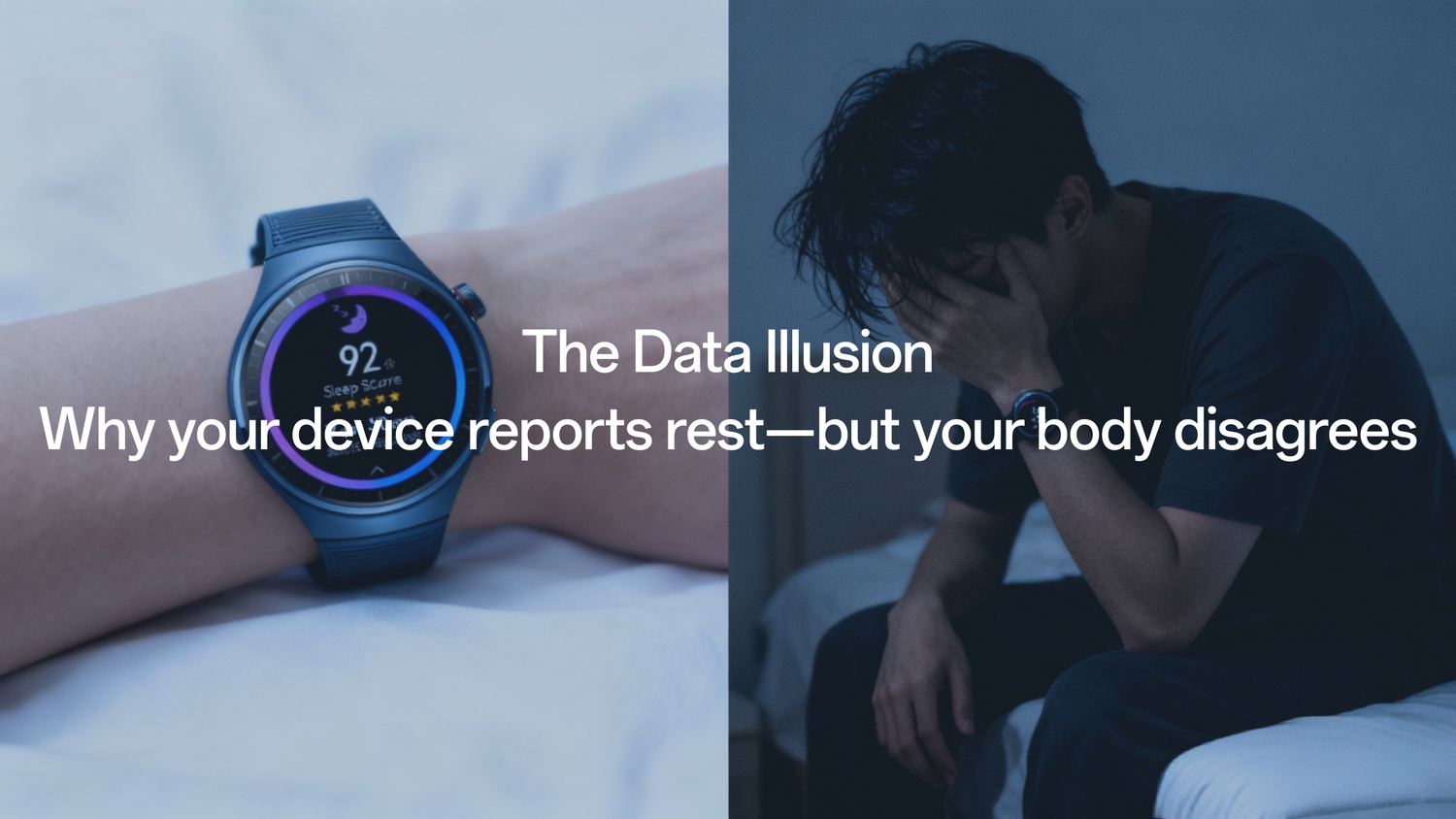
The typical human experience often begins with a contradiction: You wake up feeling foggy, unrested, and slow, yet glance at your device and see a vibrant graph celebrating a high "Sleep Score" and ample "Deep Sleep" minutes. Which to trust—the objective sensor data or your subjective, lived reality?
This dissonance arises from a fundamental technological gap. While Polysomnography (PSG) remains the clinical gold standard for detailed sleep assessment, consumer sleep trackers (CSTs) are inherently prone to bias due to their reliance on accessible, non-EEG signals. Our goal is not to dismiss these tools, but to empower you to move beyond the flawed "sleep report card." Your wearable should be used as a reliable steering wheel for behavioral adjustments, not a judge of your nightly performance. The journey to genuine sleep improvement begins by understanding the limitations of the data on your wrist.
I. The Data Illusion: Why Your Device Is 'Telling a Simplified Story'
The truth is, your device isn't lying—it’s just telling a simplified story. This simplification is driven by proprietary algorithms designed to prioritize comfort over clinical precision, often resulting in a systemic bias toward "reporting happy news".
The Structural Bias in Wake Detection
The most significant structural flaw across wrist-worn devices is their inability to accurately detect Wake After Sleep Onset (WASO)—the total time spent awake during the night.
This problem stems from the hardware itself. Most consumer wearables rely heavily on the accelerometer to detect movement, supplementing this with heart rate (PPG). Since many individuals, particularly those with chronic insomnia, often lie still in bed while awake and attempting to sleep, the algorithms misinterpret this quiet wakefulness as actual sleep.
Let’s decode what’s actually happening: Studies consistently show that while these devices are highly effective at detecting sleep (high sensitivity, often $\geq 86%$), their ability to detect wakefulness (specificity) is comparatively poor. This is where the error creeps in. The algorithm defaults to light sleep (LS) when uncertain, effectively smoothing out the edges of reality. As a result, validation studies comparing CSTs against PSG find that devices systematically overestimate Total Sleep Time (TST) and Sleep Efficiency (SE).
- The Psychological Impact: This systemic bias means that the detailed, minute-by-minute breakdown of your sleep stages is prone to error, especially the time spent in WASO. Research examining various wearables and actigraphy confirms a tendency to largely underestimate WASO due to difficulty detecting non-moving wakefulness. This makes the resulting nightly score highly misleading, as the device is designed to reassure, not reveal the true extent of wakefulness.
The immediate implication is clear: if you wake up feeling tired, but your device reported excellent efficiency, trust your subjective experience over the device’s generous score.
II. The True Signal: Your Body’s Physiological Trend Map
If the precise minute counts for specific sleep stages are unreliable, what should we trust? That’s where the next shift begins. We need to stop chasing arbitrary scores and instead focus on the deeper physiological signals that reliably indicate biological recovery.
Sleep is deeply intertwined with your Autonomic Nervous System (ANS). During the day, the ANS operates under sympathetic ("fight-or-flight") dominance; but at night, it shifts dramatically toward parasympathetic ("rest-and-digest") dominance, which is essential for physical and cognitive recovery.
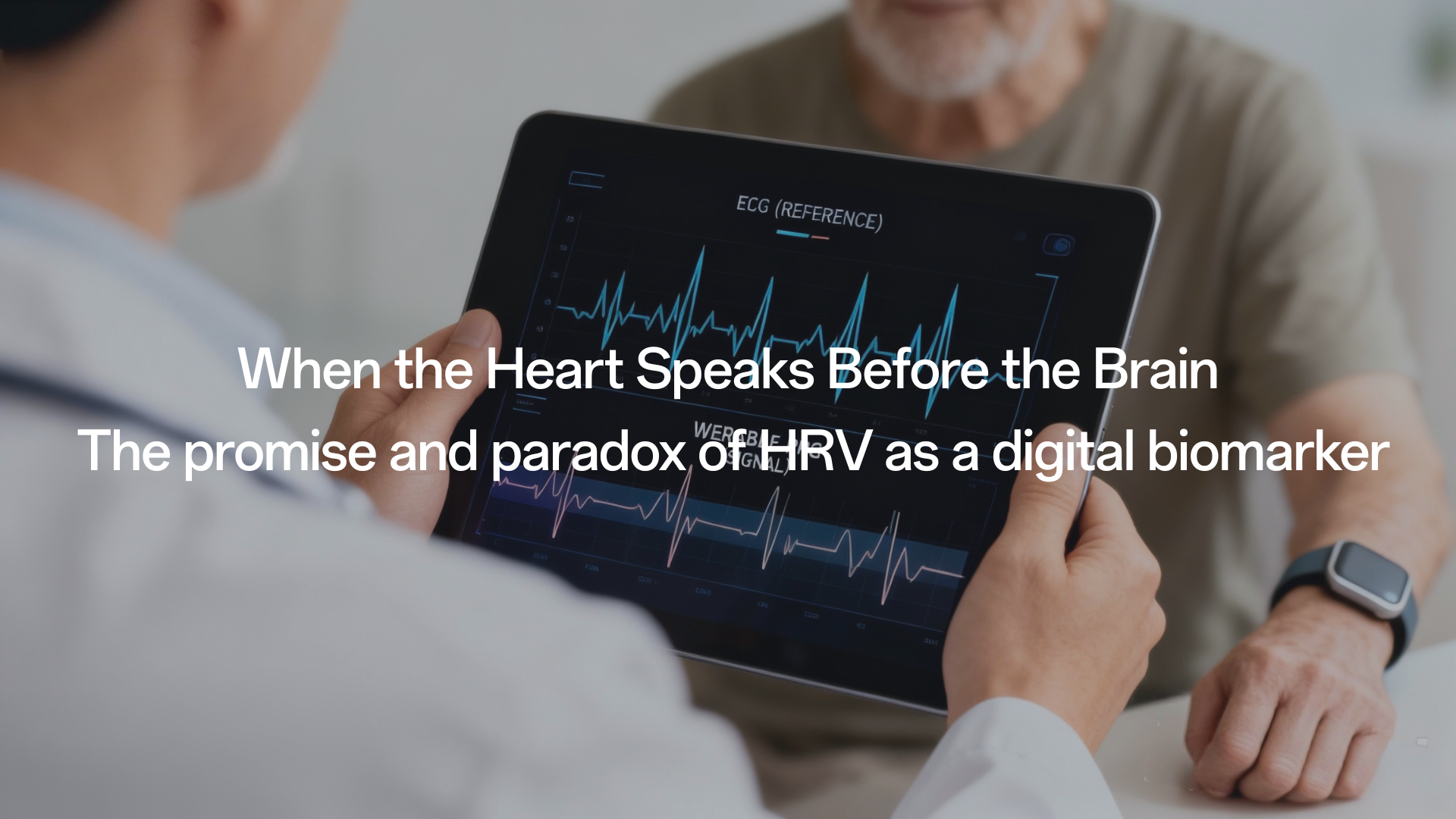
That’s why Heart Rate Variability (HRV)—captured by the PPG sensor—is critical. HRV measures the fluctuation in time between heartbeats and directly reflects the state of your ANS. As sleep progresses to deeper stages, parasympathetic activity gradually increases. Therefore, HRV is a much more important indicator of deep sleep quality than simple motion data. Studies evaluating three-stage sleep staging confirm that motion features are the weakest predictors, indicating that heart rate features hold much greater predictive importance.
- Interpretive Value: What this means for you is simple—don't stare at the specific "Deep Sleep" duration, as multiple validation studies show CSTs have mixed performance in multi-stage classification, with moderate agreement at best (Cohen's Kappa ranging from 0.20 to 0.52). Instead, you should monitor your long-term HRV trend. A consistent decline in HRV over several days signals accumulated physiological stress or inadequate recovery.
This perspective transforms your device from a flawed calculator into a tool for monitoring the trajectory of your physiological recovery, guiding you toward necessary behavioral changes.
III. The Future: AI Coaches and Closed-Loop Correction
But the story doesn’t end with tracking. The next chapter of sleep technology is about real-time correction. Advanced AI is quickly bridging the gap between passive monitoring and proactive intervention, enabling personalized coaching with expert-level knowledge.
1. Expert-Level AI Guidance
The future of personalized health monitoring involves sophisticated AI models, like the Personal Health Large Language Model (PH-LLM). This specialized AI is designed to synthesize aggregated daily-resolution numerical sensor data—including up to 20 sensor features from wearables over at least 15 days—to generate individualized insights, potential causes, and actionable recommendations.
- Why this is a game-changer: This AI represents a breakthrough in domain knowledge. PH-LLM achieved an accuracy of 79% on multiple-choice examinations in sleep medicine, slightly exceeding the performance of a sample of human experts (76%). This demonstrates that the model possesses a level of expert domain knowledge necessary to offer recommendations far beyond generic sleep hygiene advice.
- Connecting Data to Feelings: Furthermore, PH-LLM effectively predicts Self-Reported Sleep Quality (PROs) using the multimodal sensor data. This ability to infer your subjective experience from objective metrics is critical for tailoring a holistic and truly personalized action plan.
2. Real-Time, Closed-Loop Intervention
Beyond coaching, specialized wearables are already demonstrating the power of real-time intervention to overcome the common problem of Sleep Onset Latency (SOL), or difficulty falling asleep.
- The Evidence of Intervention: Systems like the "Earable" headband, which use EEG signals combined with accelerometers and PPG, employ a real-time, closed-loop feedback model to promote faster sleep. By continuously assessing the user’s "sleepiness level" via a Probability of Being Asleep (PoAs) parameter, the system can automatically deliver tailored auditory stimuli to evoke appropriate brain responses. Large-scale evaluations have demonstrated the efficacy of this non-pharmacological real-time stimulation, successfully shortening the duration of falling asleep by an average of 24.1 minutes.
This technology confirms the paradigm shift: the most effective tools will be those that monitor your physiological state and adapt their behavior in real-time to guide you into sleep.
V. Actionable Guidance: How to Use Your Wearable Smarter Today
You do not need to wait for expert AI to be widely deployed. By adopting a "Steering Wheel" mindset, you can immediately utilize your existing device to gain more accurate, actionable insights.
The goal isn't perfect sleep—it's better awareness. Your wearable can’t tell you exactly how you feel, but it can help you notice when your body is struggling to recover.
| Step | Principle | Example of Implementation | Scientific Support (Citations) |
|---|---|---|---|
| Step 1 | Establish Trend Awareness | Ignore the score, track the week. Focus on the long-term trend of your TST and SE to gauge consistency, rather than chasing a specific nightly deep sleep score. | CSTs are better suited for capturing longitudinal trends and changes in sleep patterns, despite systematic biases in stage metrics. Sleep regularity is a stronger predictor of health outcomes than sleep duration. |
| Step 2 | Decode the Body's Recovery Signal | Monitor HRV and SOL trends. Treat a consistent drop in HRV as a signal of accumulated stress or fatigue. If your SOL is consistently high (e.g., > 30 minutes), recognize this as a key area for intervention. | HRV reflects the Autonomic Nervous System and is critical for assessing physiological recovery, especially deep sleep quality. Real-time acoustic stimulation can significantly reduce SOL (e.g., by 24.1 minutes), confirming its high potential for targeted behavioral change. |
| Step 3 | Adopt a User-Centric View | Self-correct the algorithm and monitor timing. If you have fragmented sleep, recognize that the device likely underestimates WASO. Focus on maintaining consistent bed and wake times. | The "user-centric (TSP) algorithm" was developed to more accurately classify primary sleep by stitching together fragmented sleep logs (correcting WASO/TST misestimations) in high-variability groups, particularly those with insomnia. |

Lämna en kommentar
Denna webbplats är skyddad av hCaptcha och hCaptchas integritetspolicy . Användarvillkor gäller.