

Introduction: The Illusion of Instantaneous Truth
The modern wearable device is marketed as an omniscient observer: a tool delivering a constant, real-time stream of objective physiological data. Millions rely on these wrist-worn trackers to precisely measure the immediate physical toll of a workout, chasing specific heart rate (HR) peaks or monitoring recovery down to the beat. Yet, a robust and growing body of scientific evidence suggests that this faith in instantaneous accuracy is misplaced.
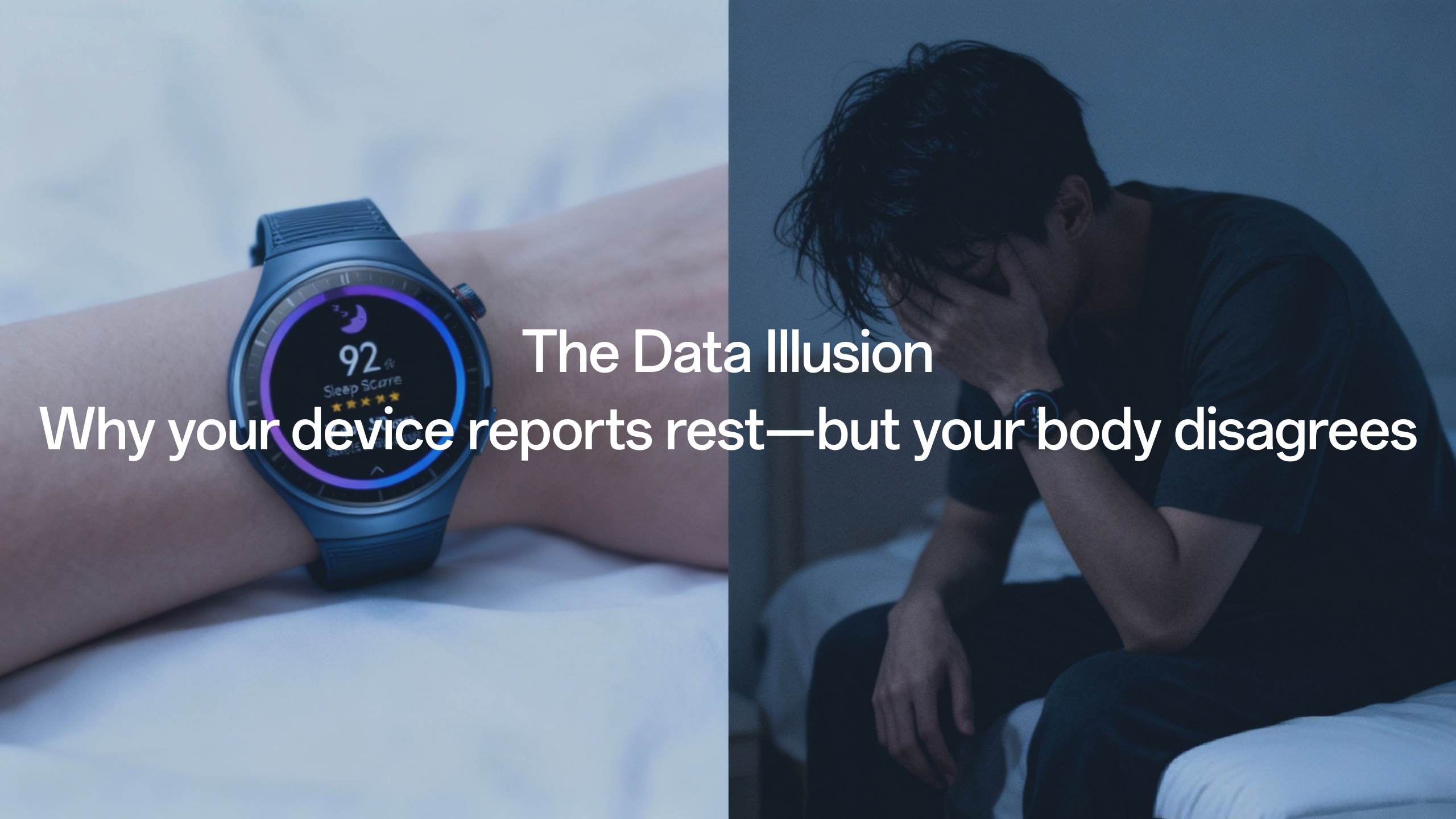
While these continuous monitoring devices have revolutionized long-term health tracking and risk stratification, their core technology struggles precisely with the dynamics that define intense physical effort—the sharp spikes and rapid changes. This analysis asserts that wrist-worn optical monitors are highly effective "Trend Experts"—reliable curators of general patterns and stable metrics—but must be dismissed as "Instantaneous Detectives" when precision across seconds is demanded. If you have ever wondered why your monitor lags behind your sprint—this is why.
Chapter 1: The Core Technical Challenge: Why Optical Sensors Struggle with Motion
The primary limitation of wrist-worn monitoring lies in the technology itself: Photoplethysmography (PPG). PPG estimates heart rate by measuring minute changes in blood volume using light. This non-invasive method is inherently compromised by the body’s movements, especially when measured at a distal site like the wrist.
1.1. The Fragility of the Signal: Motion Artifacts as Noise
The pervasive problem of motion artifacts is the primary source of signal degradation in wrist-worn optical sensors.
When the user is in motion, even slight movements of the hand or arm cause the PPG sensor to displace relative to the skin, which distorts the light signal and impairs blood flow measurement accuracy. Across multiple trials, researchers consistently found that the accuracy of HR measurements declines during physical activity compared to stable conditions, as the sensor signal is highly susceptible to this noise. This flaw means the device's ability to operate as an instantaneous detective is often compromised the moment a user begins a dynamic activity.
1.2. The Black Box of Data Averaging
The perceived success of these devices in reporting average heart rates is often a direct result of data processing designed to smooth away the inherent noise.
Manufacturers commonly utilize proprietary algorithms and undetermined filters to process the noisy raw PPG signals, deliberately sacrificing real-time detail to achieve a cleaner output. This process transforms the noisy, beat-by-beat data into aggregate time-series that summarize the physiological trend. In controlled studies, performance metrics like MAPE consistently improve with larger averaging windows (e.g., moving from per-second to 10-second or 60-second averages), confirming that this data smoothing strategy is used to mask transient errors and variability.
The paradox is clear: Your device appears more accurate not when it's capturing every precise heartbeat, but when its sophisticated software is ignoring the imperfections of the moment to deliver a reliable average.
Chapter 2: The Critical Failure Zone: Instant Accuracy Breaks During Rapid HR Changes
If the wrist device is fundamentally optimized for averaging (the "Trend Expert" role), its performance logically collapses during periods of rapid, acute changes in heart rate—known as transient states. This is where accuracy failure matters most for athletes and clinical interpretation.
2.1. The Systemic Breakdown During "Transitions"
Performance consistently drops in clinical and simulated settings when heart rate suddenly accelerates into a transient state. This difficulty in detection leads to a systemic breakdown in accuracy when users need it most.
- Error Exacerbation: Studies simulating real-life conditions—including varied-intensity walking and rest—confirm that performance notably declined across all wrist-worn devices during transient states.
- Transition Peaks: One validation study found that a specific rapid transition phase (Transition 2: sitting to walking) consistently resulted in the highest Mean Absolute Percentage Error (MAPE) values across devices, often exceeding $8%$ to $12%$. This demonstrates the vulnerability of PPG to the abruptness of the change.
- Motion Onset: The combination of motion onset and the large step change in heart rate during transitions is key to exacerbating the measurement errors.
2.2. Underestimation at Maximal Effort
The consequence of this signal lag and artifact is a systematic tendency to underestimate heart rate, particularly when intensity is highest.
- High-Intensity Underestimation: Studies evaluating wrist-worn devices during maximal exercise testing found that HR estimation errors increased above the anaerobic threshold (AT). For example, in patients with cardiovascular disease (CVD), HR underestimation was significantly more pronounced during exercise above the AT compared to the rest phase.
- The Lag Problem: This inaccuracy is compounded by measurement latency—a proven delay in the PPG device's response to sudden HR changes. This lag means that by the time the monitor registers a high reading, the true physiological peak may have already passed.
- The Impact on High-Intensity Sports: In modalities involving complex or irregular motion patterns, the difficulty is acute. A study evaluating devices during mountain biking (MTB) found that nearly all wrist-worn devices failed to meet the acceptable validity thresholds (MAPE $<10%$ and CCC $>0.7$).
2.3. The Contrast in Clinical Populations
The performance drop is intensified in vulnerable groups, such as patients with heart failure (HF), who may experience reduced peripheral perfusion. In one analysis of CVD patients, the overall HR accuracy of a wrist-worn device declined in patients with HF (Stage C) compared to those who were more stable (Stage B). In these contexts, accurate monitoring of high-intensity effort is crucial, yet the risk of an inaccurate reading (like underestimating HR) is highest.
Chapter 3: The True Expertise: Reliability in Long-Term Trends
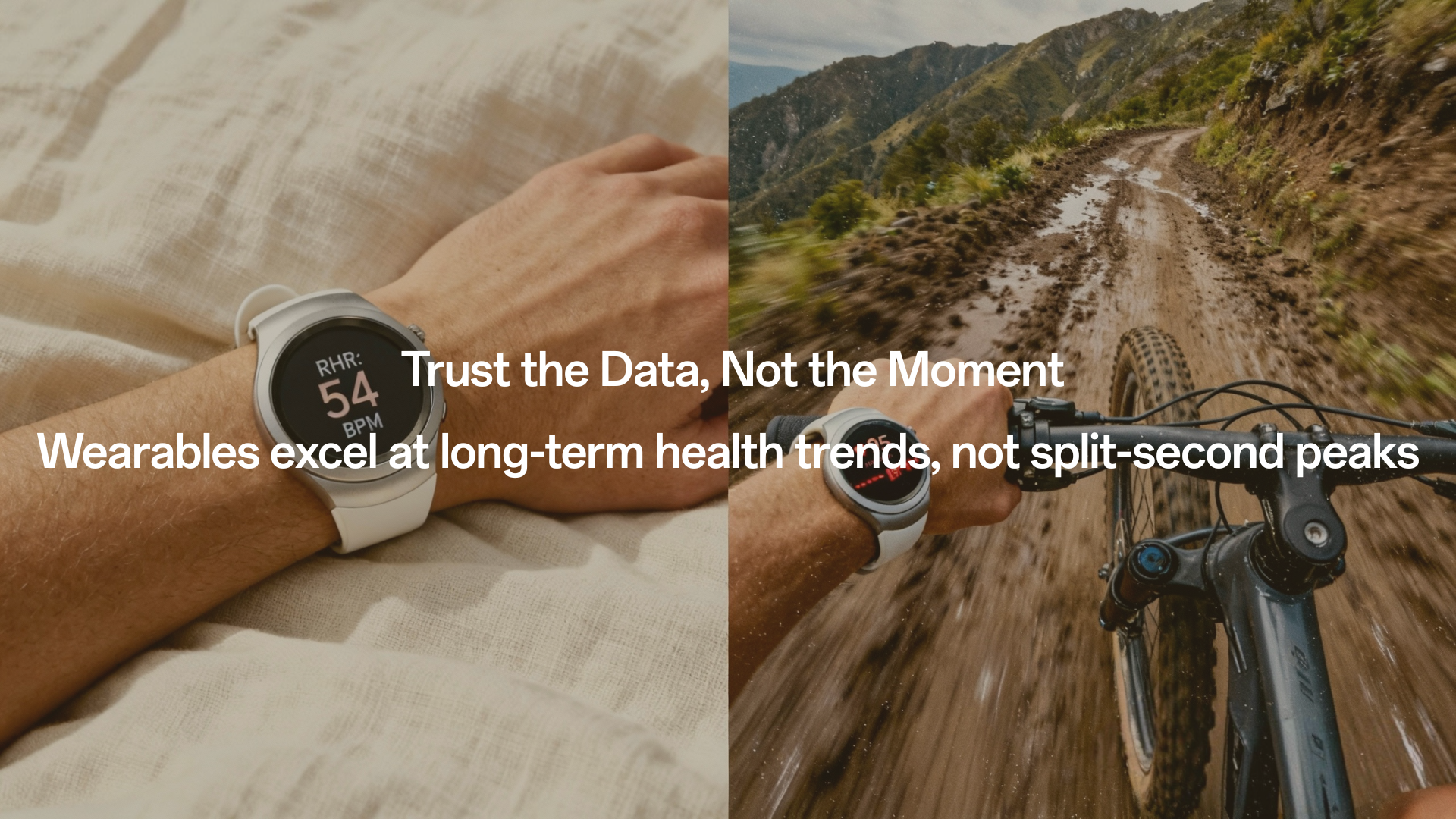
While wrist-worn devices are poor detectors of instantaneous peaks, they provide stable, high-value data when the body is in a state of rest or low-variability movement, establishing their role as the "Trend Expert."
3.1. Unquestioned Accuracy in Rest and Sleep
The strongest evidence for the reliability of optical monitors is during stable periods when motion artifacts are naturally minimized. The calmer you are, the smarter your watch becomes.
- RHR Excellence: Resting heart rate (RHR) is measured with high accuracy by consumer devices. In a study of nocturnal monitoring using finger-worn rings, RHR accuracy achieved a Lin's Concordance Correlation Coefficient (CCC) of $0.97$ to $0.98$ with a Mean Absolute Percentage Error (MAPE) of less than $2%$ compared to a reference ECG. These low error margins (Mean Absolute Error ranging from $0.98$ to $1.78 \text{ bpm}$) are considered clinically negligible.
- HRV Tracking: Heart rate variability (HRV), a complex biomarker used for recovery and stress assessment, is also measured reliably during sleep by high-performing devices. The highest performing ring devices achieved CCC values for HRV up to $0.99$ during sleep.
- Clinical Significance of Trends: A chronically elevated RHR is a strong independent risk factor for all-cause mortality and adverse outcomes in individuals with cardiovascular disease. By providing continuous, reliable tracking of RHR and HRV trends over weeks and months, these devices offer long-term health insights that are critically valuable.
3.2. Data Accessibility and Clinical Utility
The continuous, long-term nature of wearable data is what makes it revolutionary in clinical care, even with its instantaneous limitations.
- Arrhythmia Detection: Certain wearable devices provide high diagnostic accuracy for detecting abnormal heart rhythms like Atrial Fibrillation (AF), based on systematic reviews. While the rhythm monitoring often requires manual review of tracings in about one-fourth of cases in a clinical setting, the ability to screen large populations for AF demonstrates the devices' potential for population health.
- Research Accessibility Challenge: Despite providing some HR data by the second, no manufacturer currently allows for the export of continuously recorded raw signals (like PPG or accelerometry data) for off-line analysis. This lack of transparency into data filtering prevents external researchers from fully understanding the limitations and algorithms used to generate the "smooth trends".
Chapter 4: How to Interpret and Apply the Data
The key to maximizing the utility of wearable technology is acknowledging its inherent strengths and choosing the monitoring tool appropriate for the intended goal.
4.1. The Right Tool for Precision: ECG Gold Standard
For training or monitoring scenarios that hinge on capturing peak, instantaneous data—where a momentary error could compromise safety or performance—the wrist-worn optical monitor must be bypassed in favor of ECG technology.
- Chest Straps Maintain Superiority: Chest-worn devices utilizing ECG technology—like the Zephyr device—are confirmed to be robust and highly accurate during dynamic conditions. These devices demonstrate superior performance in capturing transient heart rate behavior and exhibit robustness to movement, maintaining lower error (median MAPE $<5%$) across all transitions.
- Alternative Placement Improves PPG: PPG accuracy is strongly influenced by wearing position. Studies show that optical sensors worn on the upper arm, which is a more central location, achieve far higher accuracy (overall MAPE $1.35%$ and CCC $1.00$ in one study) than those worn on the wrist, making them a strong alternative to the chest strap when arm movement is low.
4.2. The Right Mindset for Interpretation
When interpreting data from wrist-worn devices in dynamic contexts, users must adopt a mindset that accepts moderate accuracy for high-intensity activity, rather than demanding perfection.
- Context is King: The stability of some wrist-worn devices (e.g., those found in controlled dynamic studies) allows them to maintain a median MAPE below the $10%$ acceptability threshold even during transitions, making them suitable for applications requiring moderate accuracy during non-steady-state changes. However, devices that perform poorly show a large drop in accuracy during transitions involving motion onset or large step changes, making them highly unsuitable for high-intensity sports or fast start/stop activities.
- The Timeframe Rule: The reliability of these devices is highest during sleep, recovery, or stable low-intensity activities (where HR is below the median for the activity). Conversely, high-intensity exercise (above the AT) and rapid transition phases introduce significant variability that can lead to large errors and high uncertainty in the reported metric. If the reading is intended for long-term pattern analysis (months of RHR), it is trustworthy; if it is intended for a 10-second sprint interval, interpret with extreme caution.
Conclusion: Trusting the Long-Term Story
The evidence shows that consumer technology has achieved remarkable feats, providing continuous, longitudinal data that was once confined to expensive clinical settings. Wearables have successfully digitized the long-term health biography and continue to offer actionable insights into trends like RHR and HRV. The failures we observe during maximal effort are not a sign of poor engineering, but a fundamental challenge rooted in the physics of light, skin, and motion, requiring proprietary algorithms to smooth away the moment's chaos.
In other words, wearables don’t fail us—they simply tell a different kind of truth.
The limitations are simply a context of use. Wrist-worn devices are indispensable as Trend Experts and reliable historians of your physiological patterns. But when faced with the volatile, split-second demands of high-intensity performance or clinical monitoring, they are, and remain, Flawed Detectives. Users must respect the physics: choose an ECG-based device for precision, and trust your wrist-worn monitor for the big picture.

Lämna en kommentar
Denna webbplats är skyddad av hCaptcha och hCaptchas integritetspolicy . Användarvillkor gäller.